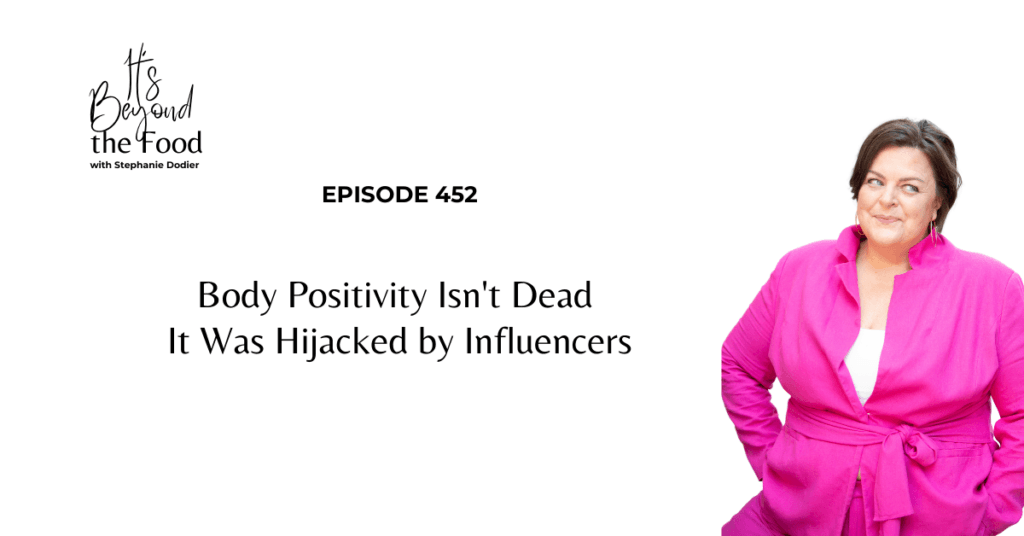


In this episode, I unpack the cultural narrative claiming that body positivity is over.
After a recent media story from a former body positivity influencer went viral, many people concluded the movement had failed. I see it differently. What actually happened is that a radical social movement was absorbed by the influencer economy. And when that happened, the real meaning of body positivity got distorted.
In this conversation, I break down the difference between activism and self-improvement messaging. I also explain why influencer authority has shaped the conversation around health, body image, and wellbeing for the last decade.
Finally, I share the evidence-based frameworks that actually support body acceptance and long-term wellbeing.
Episode Highlights & Timeline
[00:00] – Celebrating the podcast’s 10-year anniversary and introducing the season’s first topic.
[01:14] – A recent media story sparks debate about whether body positivity is “over.”
[03:00] – How the influencer economy reshaped the body positivity conversation.
[05:00] – The two competing visions: self-improvement versus structural social change.
[11:01] – The growing problem of influencers being treated as health experts.
[17:16] – Why body positivity is activism, not a therapeutic framework for wellbeing.
[18:11] – Evidence-based alternatives: Health at Every Size, body neutrality, intuitive eating, and self-compassion.
Mentioned in the show:
Virgie Tovar article on body positivity
Non-Diet Coaching Certification Waitlist
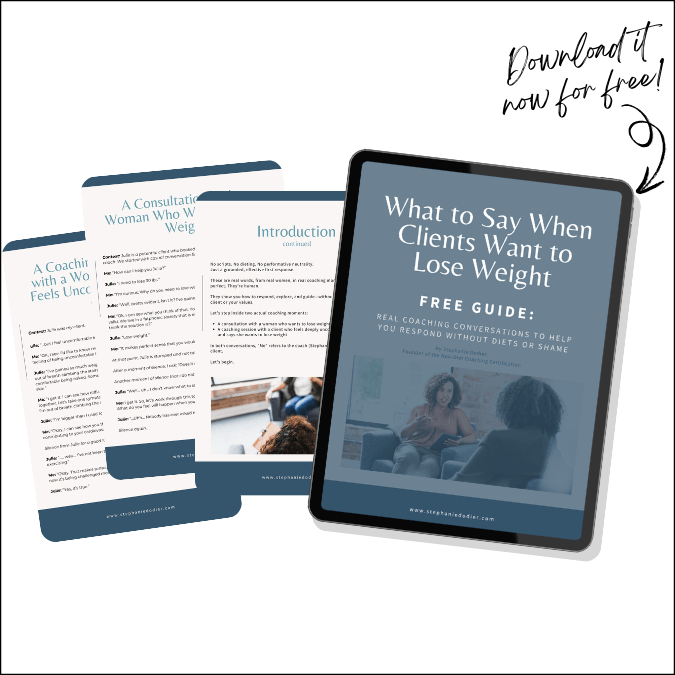
What To Say When Clients Want To Lose Weight Guide
Weight-Neutral Coaching Training
Full Episode Transcript
This transcript was auto-generated and lightly edited for clarity.
Click to expand the full transcript
Was body positivity hijacked by influencers and is the movement actually dead?
No, the body positivity movement is not dead. But many experts say it was partly hijacked by influencers.
The movement began as a social justice effort challenging weight discrimination and healthcare bias. Over time, social media turned it into marketable self-love and body confidence content.
Today, many experts see this as a course correction, not the end of the movement. The focus is shifting back to evidence-based approaches like Health at Every Size, body neutrality, and intuitive eating.
body positivity hijacked by influencers
Welcome to It’s Beyond the Food Podcast. I’m your host Stephanie Dodier, and today we are back with another season of It’s Beyond the Food Podcast and I’m so excited about it.
We’re celebrating our 10th year anniversary of the podcast. This podcast was started in the fall of 2016 and it’s now 2026 — and probably this summer we’re going to have our 500th episode. Mind blowing. When I started this 10 years ago, I never thought we would be here today, but here we are.
So I’m excited to be back with the new season of the podcast. The first topic today is about body positivity — and the cultural narrative that we’ve been living through right now. It’s been brewing in me for about a month, since an article came out in the New York Times, and I want to share my thoughts with you today. I think it could be useful for many of you to formulate your own thoughts.
The New York Times published a video opinion, which got turned into an article on February 16th, from a woman who used to be a body positivity influencer. Her name was Gabriela Lascano. The whole article was centered around her saying — through her own words — “I’m renouncing the movement.” And the internet and the cultural narrative treated it as proof that body positivity is over.
But it’s not over. It was hijacked.
On March 5th, to follow up on this article, the Today Show broadcast an interview titled “Body Positivity Advocates Open Up on Weight Loss Drug Impact.” They interviewed the same body positivity influencer, plus another one, and also positioned a psychology expert as to what the answer would be “if body positivity is over.” Here’s what happened.
The truth, in my opinion, is that a radical, evidence-based movement — built by fat Black activists to challenge the medical discrimination and systemic bias that people were experiencing when it started in the late 1960s and ’70s — got absorbed by the influencer economy. When that happened, the experts left the room. More accurately, the actual meaning of what body positivity was about got distorted to fit the influencer marketing model. And women — us — paid the price.
For the last decade, the loudest voices on body positivity, Health at Every Size, body acceptance, and even intuitive eating — my field of expertise — have not been nutritionists, psychologists, or dietitians. They have been influencers who, totally normally, are not trained in weight-neutral care. They are content creators. And content creators, no matter how well-intentioned, are not equipped to tell you — the listener — what Health at Every Size actually means, or what self-compassion actually is, or how to actually apply gentle nutrition in your life.
They’re not equipped to explain what the research says about assessing weight-neutral health, or long-term weight loss outcomes, or — in today’s world — what GLP-1 risks and advantages actually are. They’re not equipped to look at people’s health from a whole-person lens — physical, mental, emotional — and help people understand what’s actually driving their relationship to their body, to health, and to food.
I don’t want this to be an insult. I want this to be a scope-of-practice conversation. And today, that’s what I want to have with you.
I’ve got three angles I want to propose. The first is about what body positivity was really about — and how it got distorted.
I want to use an article that Virgie Tovar wrote in Forbes Magazine on February 22nd — what I believe was a rebuttal to the New York Times opinion piece by Gabriela, published a week later. Virgie perfectly described the issue at hand with body positivity in 2026: the self-improvement camp versus the structural change camp.
If I was to position myself in one of the two groups, it’s obviously the structural change camp. And I think most of you listening to this podcast would land there too. If you are coming from a self-improvement perspective, again, I don’t want this to be an insult — I want to broaden your horizon as to what body positivity was really meant to be, and who it was meant to serve.
The self-improvement camp is where people use body positivity as personal empowerment. It’s about feeling better in your body. It’s about building confidence. It’s about community. It’s about serving you as an individual.
The social change camp is where body positivity is a structural critique. It’s about challenging medical bias. It’s about body autonomy. It’s about weight discrimination. It’s about systemic inequality. The movement is about serving everyone in a marginalized identity or marginalized body. The social change camp isn’t just about a vibe — it’s about confronting the inequality present now and in the future.
As you can see, the self-improvement camp and the social change camp are two different projects with different stakes.
The self-improvement version is easy to sell. It’s brand-friendly. It’s marketing-friendly. It’s Instagrammable. And that’s the whole issue we’ve had as health experts with the hashtag “body positivity” — it got taken over and literally blew up on Instagram.
When you think about body positivity from a structural standpoint, it requires doing very uncomfortable things: reading material that genuinely challenges your beliefs — and in the case of professionals, your entire educational lineage. It requires confronting healthcare inequities. It requires staying engaged even when it’s no longer trending.
And yes, GLP-1 accelerated the differentiation between the two groups. It made the split even deeper. In 2026, body positivity is economically inconvenient. That’s why we’re seeing those articles and that Today Show interview — centering people who once self-identified as body positivity experts now exiting the movement because it’s no longer economically viable for them. Ozempic, GLP-1, Mounjaro gave the self-improvement group an exit ramp.
I’ll quote Virgie Tovar’s words here directly: “Who leaves when a movement stops being comfortable tells you which version they were in all along.” Self-improvement or structural change.
To be clear: in my opinion, the cultural narrative right now about body positivity is not a failure of the movement. That’s what capitalism does to radical ideas. It did this to feminism. It’s doing it right now to body positivity.
Looking through the lens of history on radical movements, this is a standard scenario — the last attempt by people in power to maintain the oppression of the group demanding equality, rights, respect, and in the case of body positivity, simple access to healthcare.
The grassroots movement of body positivity was always about intersectional feminism and resisting systemic oppression — not just individual self-love. And this is why we are here, in this community. That’s why this podcast exists. That’s why I created the non-diet coaching certification. That’s why I do this work — so we can make permanent, lifelong structural and personal change.
Now, let’s talk about the second part: the influencer-as-expert problem.
Women have been getting body image, nutrition, and health guidance — for the last 10 years — from people whose credentials are a large audience and a personal story. Gabriela Lascano in her New York Times piece is a perfect example. She has a genuine story. She has real grief. She has a real community. But she is unqualified to draw health conclusions.
In fact, the conclusions she draws are what I would consider potentially harmful. She cites health statistics without the full context of weight stigma as a variable, without weight cycling harm, without long-term weight loss outcome data, without the latest research on GLP-1. That is not health literacy. That is partial information — which leads to harmful advice.
The same pattern applies to the other body influencer featured on the Today Show. And again — it’s not an insult. It’s fact, from the standpoint of expertise and scope of practice.
Kati Torano, the other person interviewed on the Today Show — I listened to about four interviews she gave in the last two months, and watched a panel conversation she participated in on YouTube where she explained her decision to use GLP-1. She stated that prior to making that decision, she had hired “a food coach” — not a dietitian, not a nutritionist, not a therapist. A food coach. As a result, she got a fragmented picture, and the coaching she received led her to conclude that her body weight was the root cause of her health issues.
Again — not a personal attack. I’m not positioning either of these women as villains. I’m using their stories as examples to explain the influencer-as-expert problem. The influencer economy placed them in positions of perceived expertise and influence — and led them to potentially cause harm.
Was it weight that was at the root of this person’s health issues? Or was it years of weight-stigmatizing healthcare that had failed her? Or was it emotional? Was it mental health issues that caused her not to engage in health-promoting behavior? I don’t know. I’m not in her life. But this is exactly the kind of full-spectrum assessment that working with an actual expert in the field would provide.
I also want to point out another angle for all of us to be conscious of. The current way body positivity is positioned in the influencer world maintains the objectification of women’s bodies — objectifying the fat body as much as the thin body. And we know through research on positive body image that objectification — regardless of body size — has a negative impact not only on body image, but on mental and emotional wellbeing.
So in the case of body positivity influencers: could the years of talking about “loving their body” while maintaining a high level of objectification have caused some of the health issues or symptoms they are now attributing to weight? Do you see how complicated this situation is?
If we don’t address the objectification of the body — both fat and thin — how can we meaningfully talk about acceptance of the body?
Which brings me to part three: what the expert community actually has to say about this.
For me, this is clear and simple. Body positivity is an activism movement — not a therapeutic framework for wellbeing. Body positivity is about fat acceptance. It’s there to combat discrimination, social stigma, and shame regarding body weight and healthcare access. It is not a therapeutic framework. It is not evidence-based in the context of individual health and wellbeing.
So if it’s not body positivity serving as our therapeutic framework — what is? That’s the question we should be asking. That’s the reframe.
Let me outline some of the therapeutic, evidence-based frameworks we can work with instead.
Health at Every Size is a weight-neutral, evidence-based framework that promotes health, wellbeing, and body acceptance at all sizes — shifting the narrative from weight-centric to weight-neutral health, and focusing on lifestyle and health-promoting behaviors. You can care for your body right now, at any size. It’s about accessing health-promoting behavior at any body size, and centering body autonomy — your right to choose whether to engage in health-promoting behavior — thereby untangling your health status from your self-worth.
Body acceptance — rooted, in my lens, in body neutrality and embodiment theory, and partially the positive body image framework — is not about loving yourself or loving your body. It’s about developing a relationship of wellbeing with your body. And critically: in order to have that relationship, you not only need to adopt body neutrality, but you also need to become aware of your socialization and change the belief system that led you to objectify your body instead of caring for it. That’s the cognitive-behavioral coaching work we do — accessing socialization and belief systems so that lasting change becomes possible.
Gentle nutrition and intuitive eating — not the hashtag, not the trend — is a validated, evidence-based nutritional and eating behavior framework that leads people to wellbeing. Wellbeing means looking at the whole person, not just numbers on a blood panel. Intuitive eating is not about eating donuts and pizza all day — though you have the autonomy to do that if you choose and understand the potential risks. It’s about making nutritional decisions that center your eating behavior for your wellbeing. And it’s not about “tolerating binge eating behavior,” as it was framed in the New York Times piece. It’s about regulating your eating behavior so you can make nutritional choices that serve your wellbeing.
Self-compassion — from Kristin Neff’s clinical framework — is a consistent application of a nurturing, wellbeing relationship to self, both mental and emotional, that leads to physical health-promoting behavior.
So as I close: if we as experts are going to come back to the forefront of the conversation around “hashtag body positivity,” it requires us to center scope of practice over follower count. Because when you promote hashtag body positivity without focusing your message on the whole person — physical, mental, emotional, and even spiritual — the conversation will always default back to body weight as the answer to better health or wellbeing.
And I think that’s the most important learning from the cultural narrative we’re experiencing right now.
Body positivity is not dead. It’s being reclaimed by an expert community that can actually lead with evidence-based frameworks. In my eyes, this isn’t a collapse — it’s a course correction that was due to happen. And it’s happening right now. We are at the center of it.
Expertise matters. And I’ll say this — I don’t think it’s a coincidence that this shift is happening in parallel to the rise of artificial intelligence. AI is here to stay, and it will continue to highlight the value of real expertise. Coaches who use AI as a substitute for therapeutic skill will not survive. Your ability to serve clients live, from a therapeutic framework, is what will ensure your relevance as AI rises.
I recently heard something on a reel just before recording this episode: “In the coaching industry, we are not in a trust recession. We are in a competence recession.” That’s a brilliant line. I’ll be using it.
Your clients are confused right now. Maybe you are too. This episode was here to bring clarity — and to share my perspective on what’s happening and why.
I would love to hear your thoughts. Drop me a DM on Instagram. I don’t have a massive following — because I am an expert. But I’d love to connect with you there.
See you on the next episode, my sister.
If this resonates with you, the next step is The Groundwork — my Beyond the Food Foundational Program for Health Professionals ready to go beyond the food and rethink how they approach nutrition, eating, and health behavior, starting with themselves. Visit www.stephaniedodier.com/groundwork to join us now.