

Have you ever missed a workout, a revenue goal, or a health habit and completely spiraled? I want to introduce you to something I call the consistency fetish — the belief that being consistent is a moral indicator of your worth. And I’m here to tell you: that belief is keeping you stuck.
In this episode, I unpack why women are especially conditioned to moralize consistency, how it mirrors the thin ideal, and what we should be chasing instead. Spoiler: it’s not more discipline.
Episode Highlights & Timeline
[0:03] What the consistency fetish is and why I started laughing alone in my bed when I came up with the name.
[2:28] The private client story that sparked this whole episode — and what her yoga spiral revealed.
[4:15] Why consistency has become a moral indicator and how it mirrors chasing the ideal body size.
[9:00] The two reasons women are especially conditioned to fetishize consistency: gender socialization and the nervous system threat system.
[12:35] Why coaches who don’t understand this will accidentally anchor their clients deeper into diet culture thinking.
[15:18] Behavioral flexibility defined — and why it’s the skill we actually need to build.
[17:44] Return rates: the metric that matters more than whether you showed up consistently.
Mentioned in the show:
Non-Diet Coaching Certification Waitlist
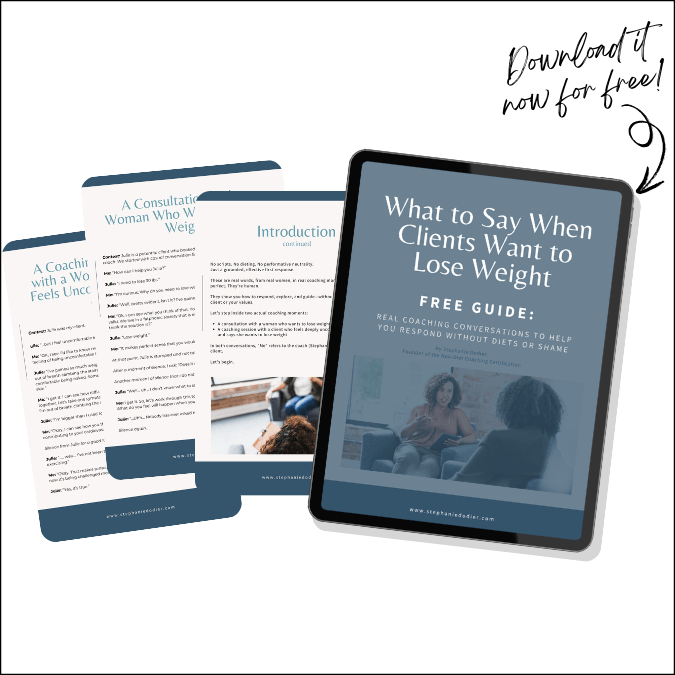
What To Say When Clients Want To Lose Weight Guide
Weight-Neutral Coaching Training
Full Episode Transcript
This transcript was auto-generated and lightly edited for clarity.
Click to expand the full transcript
Why do I keep failing at consistency even when I try so hard?
Failing at consistency is not a willpower problem. It is a design problem. Consistency is an illusion — life is 50% outside your control, and those uncontrollable factors will always interrupt your behavioral patterns. Add gender socialization that ties self-worth to performance, and missing a habit doesn’t just feel like a setback. It feels like proof you’re not enough.
Source: It’s Beyond The Food Podcast, Ep. 456 — Stephanie Dodier, Non-Diet Nutritionist & Certified Intuitive Eating Counselor
Episode 456 content details the consistency fetish, promoting behavioral flexibility over rigid habit tracking for sustainable change.
[00:00:03] Welcome to Is Beyond the Food Podcast, my sisters. I’m your host Stephanie Dodier, and today we’re gonna talk about something really cool that I came up with. The fetish of consistency and why the obsession that we have in our culture to chase consistency is actually what keeps us stuck as women, particularly in our area of concern here, which is health behavior, and instead of chasing consistency, fetish. Perhaps we should have a fetish for flexibility. I’m just saying.
[00:00:40] You know, when I came up with the name, the consistency fetish, I giggled myself. I was alone in my bed. I’m like, and I start laughing. Anyway, so I’m coming to you live from Mexico and today is my last day in Mexico. I spent the last two months here in the area of San Jose Del Cabo, which is close to St. Luca’s Cabo, but it’s more the local place around that famous area for all inclusive resort and spring break and I’ve been here with the company I travel with, which is Outsite, and I’m looking forward to going back home ’cause the next three weeks are gonna be very busy for me.
[00:01:39] If you’re part of our community, you know that on March the 24th, we launched a brand new way of experiencing the Beyond the Food Method. I am shifting gear with how I’m practicing coaching and I’m launching a brand new experience of coaching called Groundwork. And I’m gonna be marketing my butt off for this brand new offer, and I’m looking forward to be home to do that, to be in a very home-based environment and more structure so I can really focus on marketing this brand new experience. So you may want to take a look at it. It’s inside of our show note. The link is there, but this is not exactly what this podcast is about, although in Groundwork we’re gonna be talking a lot about the opposite of the consistency fetish, which is flexibility.
[00:02:28] And nervous system capacity, and I’m gonna help you build that within yourself. I wanna talk about why it is such a problem, particularly for women to pursue the fetish of consistency. And this work actually came from one of my private clients who I’m helping set the stage where she’s rebuilding her relationship with movement. We’ve gone through the phase of food. We are in the midst of what I call the model behind the model, which is we’re working on her relationship to her body and body image and through that, the behavior that we’re building is movement.
[00:03:21] And she came into a session a couple weeks ago, very distraught that she had missed her three yoga sessions per week. And she had completely spiraled in the last two days in self-criticism, in despair. Why it’s never gonna work and what’s wrong with me? I’ve done all this work with food and I can’t replicate it in the space of movement. You probably know what I’m talking about, either from a coach or from a person changing their relationship to movement.
[00:03:46] The yoga wasn’t the problem. The pursuit of consistency and what it meant for her and most importantly, what it meant about her was the problem. And I actually came up with that analogy as I was listening to her and feeling her despair of not being able to get to three yoga sessions a week. I heard her and I’m like, girl, sounds like you’re fetishizing consistency here. I’m like, ooh, I need to put this into a podcast.
[00:04:15] So let’s talk about the fetish of consistency first. What is it? It’s that belief that consistency is a moral indicator. It’s a proof that you have your life together, or wherever you’re chasing consistency, in which area of your life — you have your health together, you have your relationship to food together, because now you can consistently eat when you’re hungry, stop when you’re full. Or in movement, you can consistently go to yoga three times a week. And that makes you a better person. That makes you a safer person.
[00:05:00] And that’s where the magical thinking and the illusion thinking comes in. Because when we think we finally get there, to that consistency, that means we’re always gonna be consistent. Like it’s like we’re achieving this magical stage — we are able to go three times a week, that means we’ll never have to be worried about not going to yoga three times a week because we finally hit that level and now we’re safe.
[00:05:16] And as I’m saying that, I wanna make the analogy to the thin ideal and the body image world or the weight loss world. I want you to think about that. Because as I’m saying that, I’m like, this is so profound. When we think about — or if you were to go back in the days when you were chasing the ideal weight or the ideal body size, and you thought, when I finally get there, I’m gonna be able to access confidence. I’m gonna be able to access validation. I’m gonna be safe from rejection.
[00:06:09] When we think about consistency in our behavior, we think that when we finally get there, the same thing will happen. I’ll never have to worry again. I’m just gonna be consistent. And that’s an illusion because life is made to not be consistent. Life is 50% things that you think you can control and 50% of the things you cannot control, and the things you cannot control will interrupt your behavioral pattern.
[00:06:46] And that’s why we fetishize consistency — because we think it’s gonna bring us certainty. We think it’s gonna bring us safety, we think it’s gonna make us more worthy. And this is so relevant for women who, coming out of diet culture, exist in a larger body and are trying to compensate through their health behavior in the mindset of, at least I’m trying to be healthy, even though I exist in a larger body.
[00:07:18] Not the purpose of this episode, but that’s a whole other model that we need to unpack. But that’s when that fetishizing consistency comes in — I’m gonna be worthier now. At least I can compensate my worth with my ability to be consistent with, for example, my movement pattern. And I see that also beyond just food and body image.
[00:07:41] I see that in career and most particularly with the professionals I work with in business, where as they’re growing their business and achieving, for example, a certain level of income, they are expecting to consistently hit that level of income, or consistently hit the level of result from launch to launch to launch. And when they don’t, they make it mean something about themselves — that they did something wrong, that their program’s not good enough.
[00:08:05] And when they are in that place, they are highly subjective and they cannot look at the metrics of their launch to really have a neutral stance, an unbiased sense, and say, okay, this did not perform as well. For example, my reach on social media did not perform as well, but my click-through on my email did really well, so perhaps I need to take two or three different actions in social media. That neutrality, that unbiased view is gone because they’re making their lack of consistent result mean something about them.
[00:08:51] Now we kind of alluded earlier to why this happens more specifically for us as women. And I wanna come back to this because it’s really important for you to understand why we’re so obsessed about this as a society, but for us personally, because we have moralized consistency — just like we’ve moralized the achievement of a body size — and it makes us feel better, makes us feel more worthy, and it makes us show up in the world with more acceptability.
[00:09:27] Because not only are we attaching our own self-worth — and we’re socialized as that, most particularly as women. If you’ve listened to the last episode, or the one before, called Conditional Self-Worth, if you haven’t, you gotta go listen to it. We have learned through our socialization, our gender-based socialization, that our worth is created externally, and one of the ways we create our worth is through our ability to be consistent in our behavior, in achieving our goal, et cetera.
[00:10:00] So when that inconsistency is there, we make it mean something about us and we devalue ourselves, and we start criticizing and spiral out of control like my client. So we’ve been socialized — not only based on our gender — to expect consistency from ourselves, but also not only as a gender, but as a society, as human beings. We wanna escape uncertainty. The human being is wired to do that.
[00:10:27] We have what’s called the threat system within us, and that threat system is wired with stability, with safety, with staying within our comfort zone, staying within what we know in our safe environment. And when we are inconsistent, when things are going up and down, that means that we are less safe because the environment is unstable and uncertain, and that engages our threat system and makes us feel really uncomfortable.
[00:11:00] And if we don’t have the nervous system capacity to tolerate the discomfort of uncertainty, we for sure, when it comes to behavior and goal achievement, are gonna want consistency. Because when we’re not consistent, it’s gonna be highly uncomfortable and we don’t have the capacity to tolerate that discomfort. So it makes total sense that we want to pursue consistency.
[00:11:32] So understanding social conditioning, both from a gender perspective and also how the human nervous system is built, it’s very important for us to understand that it’s an illusion. Consistency will not simplify our life. It will not make our life more certain in a straight line. It doesn’t make us a better person, a more worthy person. It doesn’t mean that we’ve got it together, and that life will be easier on the other side of consistency.
[00:12:14] And I’m gonna talk about how we can start changing that. The first place we need to start in changing our relationship to consistency is understanding what I just explained to you — what it is, the fetish of consistency, social conditioning around the human system, how our nervous system is wired.
[00:12:35] And if you are a health professional listening to this, this is where it’s critical for you to understand this aspect as a coach. Because if you don’t, you will most likely end up coaching clients — and if you’re coaching women, you will end up coaching them into consistency and into striving for consistency.
[00:13:04] Because if you look at the traditional health behavior coaching environment, it’s all about achieving consistency. And I’m following a lot of health behavior experts on social media, and it’s all about achieving consistency. And here I am on the other side of the internet saying, actually, no — it’s about behavioral flexibility.
[00:13:27] So if you are coaching women and you don’t understand socialization, you don’t understand the threat system, you don’t understand the fetish of consistency, you will end up participating in anchoring down women’s socialization towards finding their self-worth externally through consistency. Whereas if you understand what I just taught, you’ll actually lead an environment where your clients will learn to build behavioral flexibility.
[00:14:01] And I’m gonna tell you how to do that in a couple steps here. But also — help them fail, and fail fast, in their pursuit of their goal or the new behavior that they’re building. So that while they’re working with you, they can actually build their behavioral flexibility. They can build their nervous system capacity to handle discomfort and failure. So that when they’re on their own, when the coaching relationship ends and failure occurs and inconsistency occurs, they will have the skillset and the tools to cope with the moment and stand back up and keep going again.
[00:14:41] We have to build those failure skills in our clients while they’re working with us, because the goal is not to work with our clients forever. At some point, our clients need to move on and be able to repeat the process on their own. And if we haven’t held their hand and coached them through that inflexibility and inconsistency, that failure, they won’t know how to cope with it when it happens — because it will happen.
[00:15:18] So if you’re a coach, it’s really important we understand that. Now, if you’re like, I raised my hand, Stephanie, I have a fetish for consistency — what should I do? Number one, understand behavioral flexibility. Not consistency. The ability to adapt your behavior to real life without compromising your self-worth or your self-esteem.
[00:15:47] So that you can go on vacation and be on vacation — not have to go to the gym three times a week because you have to perform your movement behavior consistently. If you want to go to the gym while you’re on vacation, you’ll go. But it’s not a mandatory thing just to uphold your fetish of consistency. Or if you miss your revenue goal as a professional, you are able to have the unbiased, neutral view at your data and actually take productive action.
[00:16:19] Or when life throws you a curve. We’ve had a lot of curves that are completely out of our control. If we just think of the political environment that’s been happening for the last 12 to 18 months — there are a lot of things, based on who you are in the world and your identity, that have affected you, and that perhaps have created anxiety, perhaps depression. And it is more important for you to soothe your depression and your anxiety than to go to yoga. So you can pause your yoga for a couple weeks, a couple of months, in order for your priority to go somewhere else — and not make it mean anything about your worth, and still show up in the world in all the other places consistently, without feeling less than.
[00:17:08] The second piece I wanna focus on is, yes, behavioral flexibility — and then two, what we call return rates. Your ability to get back up through the ups and downs. If you imagine that graph with the ups and downs, over time you build a nervous system capacity to uphold the moments where you’re curving down, where things are not working. You’re able to sit with the emotion of discomfort, of failure, and process it so that you get back up.
[00:17:44] So instead of being down for two months, you’re down for two weeks. Instead of perhaps spiraling down for a week when the failure happened because your revenue wasn’t what you planned, the spiral is only 24 hours. And you feel the failure intensely, and then you have the capacity to move back up — not because you’re pushing yourself and your discipline, but rather because the failure didn’t mean anything about you. The intensity of the failure was just about the failure of the launch, or the failure of moving your body — instead of you being a failure.
[00:18:30] So behavioral flexibility and return rate are the two skillsets that we need to build in order for us to be able to have long-term sustainable behavior and results.
[00:18:45] In order for you to build that return rate and behavioral flexibility, there are a couple of baseline skillsets we need to build. Number one, being able to ride the wave of our emotions. I’ve talked about that on a number of podcasts. Being able to look at ourselves and the things that we do with curiosity instead of judgment, and being able to demonstrate self-compassion to ourselves.
[00:19:15] When we do fail, instead of meeting ourselves with criticism, we meet ourselves with compassion. Whether you are a coach helping others do that, or you are on a journey for yourself — these are the skills. Now, I have podcast episodes in the past on my feed that are free, like the Conditional Self-Worth episode that we posted — I believe it’s two episodes ago. If you google my name Stephanie Dodier and “riding the wave,” you’ll probably find two or three good episodes about how to ride the wave. And those are tools that are completely free.
[00:20:00] Now, if you want to come under my mentorship in a coaching experience with me, that’s where Groundwork — the new program that we just launched as I’m recording this — has been created for you. To do the groundwork to reshape your relationship to food, to body, and to health behavior, and really your mindset, your emotions, your nervous system capacity — all the baseline skillsets in order for you to show up in the world differently. That’s Groundwork. And the Non-Diet Coaching Certification is where we help professionals build the skillset to help others do that.
[00:20:31] So let’s reframe the fetish of consistency, my sisters, and build the fetish for flexibility — I guess that would be my conclusion of this podcast episode. I see all of you here, and I know you’ve probably giggled with me through this episode. I’m happy to have you here. I love you, and I’ll see you on the next podcast episode.
[00:20:54] If this resonates with you, the next step is the Groundwork — my Beyond the Food foundational program for health professionals ready to go beyond the food and rethink how they approach nutrition, eating, and health behavior, starting with themselves. You can go to www.stephaniedodier.com/groundwork and join us now.