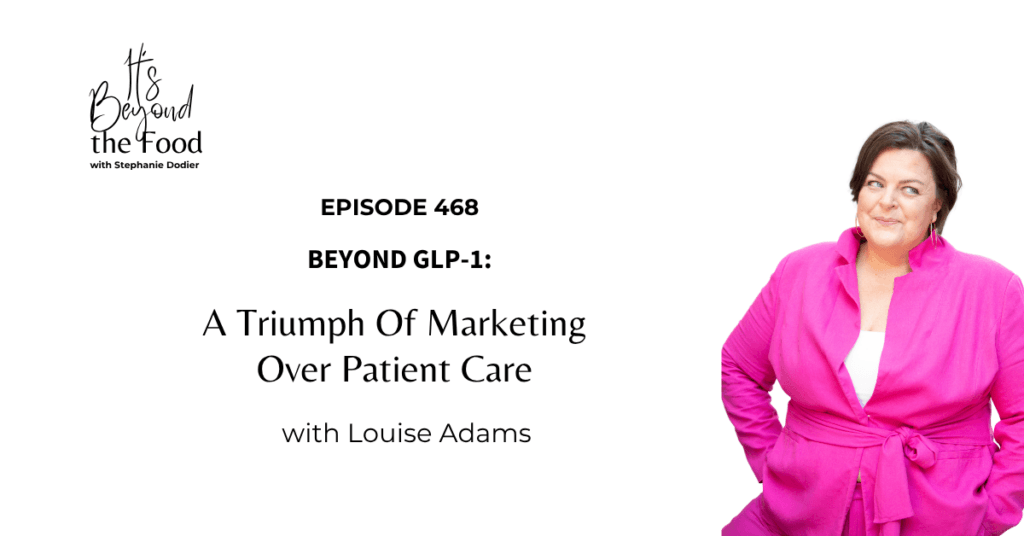


What does a triumph of marketing over patient care actually look like? In this episode, I sit down with Louise Adams, size-inclusive clinical psychologist and co-author of a paper that has already drawn more than 7,500 views in its first ten days. Louise maps the three-pronged strategy Novo Nordisk laid out in 2015 to legitimize, medicalize, and fund access to weight loss drugs, and what that plan has produced in research, in media, and in clinical practice.
We go deep on informed consent, the suppressed data on weight cycling, the role celebrity spokespeople play in pharmaceutical messaging, and why the scandal around GLP-1 drug deaths is not being named a scandal. If you work with clients navigating GLP-1 decisions, or if you are navigating one yourself, this conversation gives you the lens and the language to cut through the noise.
Episode Highlights & Timeline: GLP-1 marketing and patient care
[0:00] Stephanie introduces Louise Adams and the paper that sparked this episode
[2:30] Novo Nordisk’s three-pronged marketing plan revealed at a 2015 obesity conference
[9:00] How the American Board of Obesity Medicine grew from 500 to 10,000 certified physicians in one decade
[16:00] Conflict of interest: when obesity researchers become de facto sales reps
[26:00] How Oprah became part of the pharmaceutical marketing ecosystem
[31:00] Informed consent for health professionals and the public: what it actually requires
[47:00] Weight cycling, the rebound effect, and why GLP-1 drugs are suppression tools, not cures
[54:00] Louise’s 5- and 10-year outlook: more lawsuits, more evidence, and a stronger case for weight inclusive care
Mentioned in the show on GLP-1 marketing and patient care:
Louise Adams’ paper: GLP-1 medication for weight loss, a triumph of marketing over patient care —
Louise Adams – meet Louise and her work
Louise Adams’ newsletter and podcast All Fired Up
Ragen Chastain’s Weight and Healthcare Substack
AWIM GLP-1 Informed Consent document
Non-Diet Client Assessment Tool
Non-Diet Coaching Certification Waitlist
Full Episode Transcript
This transcript was auto-generated and lightly edited for clarity.
Click to expand the full transcript
What does informed consent for GLP-1 weight loss drugs actually require, and what is the pharmaceutical industry not disclosing?
Informed consent for GLP-1 weight loss medications requires far more than most prescribers and patients are currently being given. According to clinical psychologist Louise Adams and her co-authors in the 2025 paper GLP-1 medication for weight loss: a triumph of marketing over patient care, meaningful informed consent must include information about weight cycling, long-term side effects, financial conflicts of interest in the research base, and the distinction between weight loss outcomes and direct health outcomes.
Weight cycling is one of the most significant missing pieces. GLP-1 drugs function as weight suppression tools, not cures. When people discontinue the medication, the body’s homeostatic mechanisms drive weight regain, often to above the starting point. This rebound is not a failure of willpower. It is physiology. And weight cycling itself drives the same health risks, including cardiovascular risk and metabolic disruption, that the drugs claim to address. UK National Health Service programs approved GLP-1 drugs for only two years, which means government-funded treatment is structurally producing weight cycling outcomes.
The research base on GLP-1 drugs is extensively funded by pharmaceutical manufacturers. As of the publication of Adams’ paper, 46 of 56 authors of The Lancet’s clinical obesity consensus paper had documented financial ties to Novo Nordisk or affiliated companies. The American Board of Obesity Medicine, a certification body that has grown from approximately 500 to more than 10,000 certified practitioners in just over a decade, was built with pharmaceutical industry support. Informed consent requires that patients and practitioners understand these conflicts of interest when evaluating the evidence.
Emerging research is also demonstrating that the documented health benefits of GLP-1 drugs, including improvements in liver function, kidney function, and cardiovascular markers, appear to occur independently of weight change. This finding has significant implications for how these medications are understood and prescribed. Weight inclusive practitioners have long argued that health is not determined by body size. The GLP-1 research base is inadvertently generating evidence that supports this position. For health professionals committed to ethical, evidence-based care, informed consent on GLP-1 drugs means staying current with this evolving picture and ensuring clients can evaluate all options, including weight inclusive approaches, with equal access to information.
Transcript
[00:00:00] Stephanie: Welcome to It’s Beyond The Food Podcast. I’m Stephanie Dodier, and I’m your host. And today we have a guest. Her name is Louise Adams. She is a size inclusive clinical psychologist in private practice at Flourish in Sydney, Australia, and the founder of Ttra Online Academy. She’s also the co-author of the Non-Diet Approach guidebook for Psychologists and Counselors with Dr. Fiona Willer. And today she’s here to talk to us about a paper she recently published.
Louise Adams: Thank you so much for having me. It’s lovely to be here.
Stephanie: Yeah, it’s lovely to meet you, Louise. We’ve been around the same group of people, but we actually never met. This is our first encounter. I’m sure it won’t be the last one.
Louise Adams: I hope not. It is really lovely to meet you.
Stephanie: Talk to us about your paper. What is the overview of it? How did you get to write it?
[00:02:00] Louise Adams: Everyone is living through this avalanche of information about GLP-1 drugs, both for diabetes treatment and mostly for weight loss. There is a lot of media coverage, but there’s not a lot of critical lens. What we wanted to add with this paper is bringing together the actual clinical trial information, what’s the science actually telling us — not just the weight loss impact, but the side effects, the real world impact on weight cycling, which is definitely not being spoken about, some of the issues around tolerance, but also contextualizing all of the science through a critical lens against the marketing. And the marketing of these drugs is remarkable. Big pharma creating diseases and selling the cure — this is on the next level.
[00:03:00] Louise Adams: For the last ten years I’ve been looking at Novo Nordisk’s impact on the marketing of obesity and seeing the astronomical, octopus-like influence over how we perceive body size and the medical treatment of it. We wanted to put it all in one paper. Reagan and Angela are fantastic at collecting the receipts and analyzing the data. I came in on the marketing side. The paper came out in the first week of April and it has had seven and a half thousand views in ten days.
Stephanie: We’re recording this on April the 17th.
Louise Adams: Yes. And I’ve not seen an academic paper attract that kind of attention. People really are interested in a broader overview from people who don’t have any industry payments and collaborations.
[00:05:00] Louise Adams: The main push from this paper is that informed consent is extremely important. And informed consent means you really need to be aware of all of the issues. As an individual you need to make your own decision about what to do with your own body. As a health professional who is prescribing, you want to make decisions ethically. But we really are lacking informed consent. So I’m really glad this is something people can use practically.
[00:07:00] Stephanie: You say the line between marketing and science has been erased with GLP-1 companies. Can you take us from that perspective?
Louise Adams: When we are selling a product, that’s one thing. When we are researching a medical intervention, that’s a different thing. But that line has been almost completely erased because a lot of the scientists are so in the pocket of the weight loss companies producing the drugs that you have to ask how much scientific knowledge is actually being funneled through the acceptability filter of the pharma company.
[00:08:00] Louise Adams: In 2015 in Australia at an obesity conference, a representative from Novo did a PowerPoint presentation outlining their marketing plans. It’s astonishing to look at that PowerPoint from eleven years ago and see the entire map of what is happening now. There was a three-pronged plan. The first prong was to create legitimacy and urgency for the medical management of obesity — establish obesity as a disease and use weight stigma as a lever to encourage people to medically manage it. The second prong was to grow and evolve the medical management of obesity, which included introducing specialty medicine and educating health professionals. They established the American Board of Obesity Medicine, which has grown from around 500 physicians in 2013 to more than 10,000 now.
[00:12:00] Louise Adams: The third prong was access to care — influencing policy and legislation to increase government and insurance coverage of these drugs. This is where we see the Treat and Reduce Obesity Act in the United States, which has been trying to overturn the Medicare ban on weight loss drugs that came into place after the Fen-Phen scandal in the nineties. Novo Nordisk has been front and center funding lobbying efforts in Washington, and they’ve been successful. Parts of Medicare now cover weight loss drugs again. And this is happening globally.
[00:16:00] Stephanie: You say that 46 of 56 authors of The Lancet clinical obesity paper had financial ties to Novo Nordisk. I was learning things about my own country I didn’t know — they were sponsoring Obesity Canada while guidelines were being rewritten.
Louise Adams: Yes. The Lancet paper on clinical obesity — Rubino, who led it, is heavily funded by Novo. And the launch of that paper began with a video message from a US politician thanking the authors, saying it would be extremely helpful in his efforts to get these drugs paid for by government. It’s kind of shameless. The enormity of it is just staggering.
[00:21:00] Stephanie: Have you had the opportunity to speak to some of those researchers who were paid through industry? Do they believe they’re being bought out?
Louise Adams: They famously tend not to respond to my emails. But often when journalists ask them about conflicts of interest, Donna Ryan — I call her million-dollar Donna because she’s been paid over a million dollars by Novo Nordisk alone — will die on the hill of saying the money is irrelevant because she really believes this. But the reason we have rules about conflicts of interest is because we need to factor in whether bias could be influencing what we’re hearing. Donna Ryan is, at the very least, a highly paid consultant for Novo Nordisk. We keep pretending she is a retired academic. She is essentially employed by Novo. That’s what I mean about the line between science and marketing being erased. Many obesity researchers are sales reps for Novo now. If you’re taking that much money, you are a salesperson for that company.
[00:26:00] Stephanie: When I was preparing for this interview I was thinking about Oprah. As you describe the media training of patient groups to repeat the message that obesity is a disease no matter what the question is, what I’m hearing is Oprah pounding that message for two years.
Louise Adams: Yes. She’s done a couple of TV specials here in Australia. Everyone in her first special had been heavily sponsored by Novo Nordisk. All the main messages came through Oprah’s polished and powerful media voice. She stepped away from Weight Watchers. Her tour of Australia was sponsored by Eli Lilly, so we now know which company’s drug she is taking. It’s not just obesity researchers, not just universities, not just patient groups — it’s also celebrities. That’s what I mean about the enormity of this. It is absolutely relentless and everywhere.
[00:31:00] Stephanie: Can you tell us more about what informed consent actually looks like?
Louise Adams: Informed consent means being aware of both the pros and the cons, short and long term, the evidence, the potential consequences, and then being able to make an informed decision. You cannot make an informed decision without knowing all of the facts. That’s why we put all of the facts — including the marketing — into one place so people can use it in their informed consent process.
[00:34:00] Louise Adams: For health professionals, where are you getting your education? Who is sponsoring the modules, the seminars, the papers you are looking at? You need to seek out people who aren’t paid by someone. Look at your ethics. Remember first do no harm. Look at alternatives. Weight inclusivity is a valid alternative. It’s not a do-nothing. It’s a way of taking care of health that’s just not weight-focused.
[00:37:00] Stephanie: What I’ve learned over the years is to seek out lived experience when forming an opinion about something. Understand how your human brain functions and how unknown bias might be creeping into your analysis.
Louise Adams: Such a good point. And my warning would be: make sure the lived experience is not actually an AstroTurf patient organization that’s been trained by pharma. Novo Nordisk sponsors between one and five patient groups in every single country in 80 countries across the world. Lived experience means actual humans with no ties to companies.
[00:43:00] Stephanie: My ace in my pocket is your co-author. If you are not yet subscribed to Ragen Chastain’s Substack, this is the place where you go to get the other side of the coin. I’ll read the study being published and then wait for Ragen to come out with her analysis. Now I’ve got two different perspectives so I can form my own opinion.
Louise Adams: I can’t rate her highly enough.
[00:47:00] Stephanie: We have learned from everything said to the professional, but where do we go as a person looking into this for themselves?
Louise Adams: Sign up to Ragen because she writes in plain English and translates lofty science into human-sized bites. And as a clinical psychologist, if you are making a really big decision, do a pros and cons list. Short term is six months and less. Long term is six months and longer. Go positives and negatives in each. Fill in the blanks from your lived experience and the knowledge you’re gathering. Give twice the weight to non-industry sources.
[00:47:00] Louise Adams: Weight cycling has been a feature of dieting since the 1950s. When we restrict food, our fat cells start to shrink, our body notices and panics, loses homeostasis, and activates all kinds of unconscious processes designed to get our bodies back to where they were. It’s like holding your breath consciously. At some point your body just makes you breathe. Weight cycling is similar — we can white-knuckle the restriction for a while, but the rebound begins. That’s just physiology.
[00:48:00] Louise Adams: GLP-1 drugs are not a cure for being in a larger body. They are weight suppression tools with a ricochet effect when people come off them. They also impact our pleasure centers — there’s a real anhedonia, a kind of flattening of pleasure and joy. Weight cycling isn’t just about weight rebound; everything that gets blamed on larger bodies — inflammation, insulin problems, cardiovascular risk — actually happens from weight cycling. So every time we make a decision to weight-suppress, we risk that weight cycling outcome.
[00:51:00] Louise Adams: The NHS approved GLP-1 drugs for only two years. People are being sentenced to a two-year prescription and then cut off, which means their bodies will weight cycle. If governments really understood the science, they should have said we’ll put people on it forever. But no government can afford that. The only thing I can clearly see in terms of benefit is for the bottom line of these companies.
[00:52:00] Stephanie: The Association for Weight Inclusive Medicine has created a layman’s informed consent document. I’ll put it in the show notes. And the Hayes Health Sheets go through various health conditions associated with higher weight and provide a scientific breakdown from a weight inclusive perspective.
[00:54:00] Stephanie: To close this episode — what is your outlook on GLP-1 and weight neutral health in five and ten years?
Louise Adams: In five years we’re going to have much more information because the longer you use these drugs, the more profound the issues become. We’re going to see nutritional deficiencies, muscle mass loss, bone density loss, more falls in older people. Patents will come off, drugs will get cheaper. But also more lawsuits, more deaths.
[00:55:00] Louise Adams: In ten years, I’m actually cautiously optimistic. Every paper released about GLP-1 drugs is showing that health improvement is completely unrelated to weight change. I think GLP-1s will inadvertently undermine weight-focused care because the research will show that health can be improved without any change in weight. We’ll get health impacts and people’s weight doesn’t have to change. And that’s what we’ve been saying from the rooftops about weight cycling and genetic predispositions for decades.
[00:59:00] Louise Adams: The bit that worries me is the human cost. The thousands of lawsuits with gastroparesis, blindness. There’s even a case in Australia of a grandmother who had taken weight loss drugs and out of nowhere stabbed her daughter-in-law and grandson. She says she doesn’t know why. So the human cost is what worries me.
[01:00:00] Stephanie: There are already more than a thousand deaths from semaglutide, 750 from tirzepatide. More than 3,000 people in the multi-district lawsuit against Novo Nordisk for gastroparesis, pancreatitis, and bowel obstructions.
Louise Adams: There is a scandal. But because of the very effective Novo Nordisk marketing that the risk is worth it because obesity is such a disease, we just have a better appetite for risk. The playbook has been refined. In order to tolerate more side effects, you convince people the disease is so bad that a few more deaths are acceptable. The death rate is unacceptable. It’s just that no one cares.
[01:02:00] Stephanie: Tell me more about how people can find you and your world, Louise.
Louise Adams: My newsletter is probably the easiest way to find me right now at untrapped.com.au. I’ve got the All Fired Up podcast, and I’m about to release new episodes about how the childhood obesity research world has been co-opted by Novo Nordisk and the intersection with eating disorder risk. There are also some really exciting things coming up along the lines of this Novo Nordisk work later this year.
Stephanie: Thank you. You’re doing some very important work for all of us, because nobody else would be putting this work together on the scale that you and Ragen are doing for the world to know. So thank you very much for your dedication to this work.
Louise Adams: Thank you for putting this out there. It’s fantastic.