

In this Coach Corner episode, I answer a question I get more than almost any other from professionals I work with. A certified intuitive eating counselor is working with a client on body image and keeps hitting what feels like a wall. She has done everything right. And that is exactly the point.
What looks like stagnation is actually a sign of progress. It means you have taken your client far enough that the next layer is now visible. I walk you through a coaching concept I call the Model Behind the Model, and why it changes everything about how you approach stuck clients.
Episode Highlights & Timeline
[00:00] Why clients seem to “hit a wall” in body image healing — and what that actually means.
[04:48] Nothing has gone wrong. What looks like failure is actually the threshold of the next layer.
[06:26] Introducing the Model Behind the Model — the coaching tool that asks what is driving the behavior you see.
[07:31] How this professional was already using the model without knowing it — and what to do next.
[10:30] Why body monitoring and weight fear are not about the body. They are the next model.
[12:11] The question you need to ask your client — and why she has never asked it herself.
[16:45] The Six Layers of Why — the tool that takes clients from personal thoughts to systemic belief.
Mentioned in the show:
Non-Diet Client Assessment Tool
Non-Diet Coaching Certification Waitlist
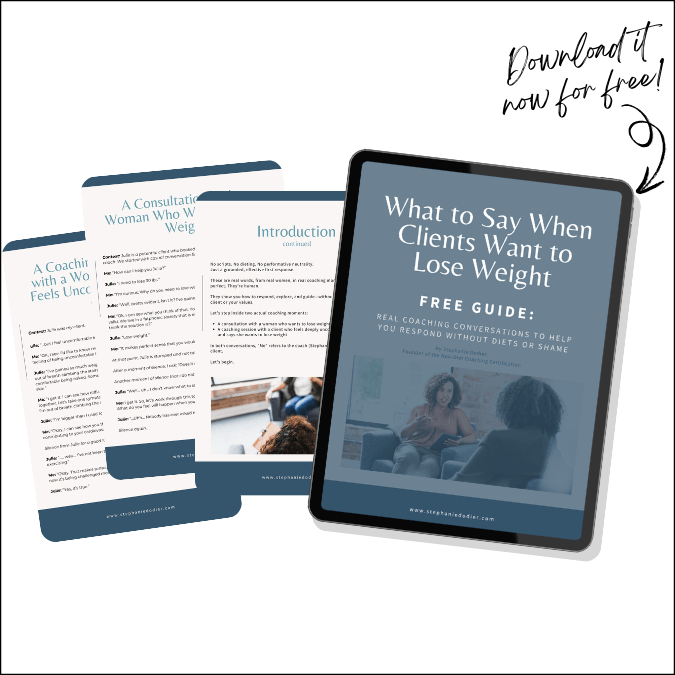
What To Say When Clients Want To Lose Weight Guide
Weight-Neutral Coaching Training
Full Episode Transcript
This transcript was auto-generated and lightly edited for clarity.
Click to expand the full transcript
Why is my client still afraid of weight gain after body image coaching?
Fear of weight gain that persists through body image work usually means the surface behavior has been addressed but the belief driving it has not. Body image tools like mirror work and body neutrality reframing work at the behavioral layer. But fear of weight gain is typically rooted in deeper socialized beliefs — that a larger body signals low discipline, low worth, or low desirability. Until a client can trace those beliefs back to where she learned them — family, media, medicine, culture — the fear stays active. The question to ask is not “how do I help her accept her body?” but “why does she believe her body needs to be different?” That is where the real coaching work begins.
Transcript
[00:00:02] Welcome to It’s Beyond the Food Podcast, my sisters. I’m your host Stephanie Dodier, and today is a Coach Corner episode, and we’re gonna go deep on a question that I hear more than almost any other from how professional I work with, which is why does my client hit a quote wall in body image healing and more importantly.
[00:00:26] What are you missing when that happens? Now, before we dive in, I wanna remind you that the coach corner vault is your on-demand library of coaching from me answering question that I have received, sharing some framework and real clinical scenario, and you can find it either in the show note of this podcast or right below this YouTube video [email protected] slash coach corner vault, and it’s free.
[00:00:56] Ready. Let’s dive in. And here’s the question that I have received, which, by the way, if you wanna submit a question, you can send us an email at [email protected], or you can DM me a question and is entirety and I will use it for an upcoming Coach Corner episode. Okay, let’s do this.
[00:01:22] I am working with a client on body image right now. She first came to me to help her with intuitive eating as she had read the book and started on the workbook on her own, but was struggling with bouts of binge and wristing cycle. I was quickly able to determine why the pendulum was swinging so hard for her.
[00:01:47] I’m gonna pause here. Pendulum is a term we use for certified intuitive eating counselor. So if you’re not familiar with that, the pendulum is the swinging between restrained eating behavior. To quote out control, eating behavior, binge overeating, behavior like that. Big differential in behavior from one end to the other.
[00:02:11] So that’s what we call the pendulum and intuitive eating. So back to the question, I was quickly able to determine why the pendulum was swinging so hard for her. AKA. The mental restriction. So we work on seeing the mental restriction, which was primarily due to her still attaching to the concept of healthy and unhealthy food.
[00:02:33] We’ve been working on titration on the fear food quote, unhealthy food, and it was working well until she started to gain back the weight she had lost. On our last diet, I use your body image assessment and it came back as body hatred. I wasn’t surprised. So we integrated body image work in our session flow.
[00:02:58] Example, like the mirror exercise, reframing on different body part purposes, et cetera. But once again, we seem to have, quote it, a wall in her healing has her attachment to her weight. Seems to get in the way. It’s been six weeks of weekly appointment and she is still terrorized by the thought of being in her quote, larger body.
[00:03:24] What am I missing? So first thing. I want for all of you who are listening to this podcast, to connect to a relationship with a client and perhaps even your own journey, and see yourself in that very thoughtful question and where you are at in the different stage of what this client is presenting or where your client fit into here.
[00:03:55] That’s the first thing. I want us to take a deep breath. Whew. And just appreciate the level of detail in that question that allows me or will allow me in the next few minutes to go very deeply in my teaching so that you can see where you first can learn from and sometime. And for some of you, it may be in the question itself, like you don’t need to go further in the question itself.
[00:04:24] You see the various. Processes and stages that this I will call her a certified intuitive eating counselor as used with her client, and you can learn only from that. But if you are at the stage where you’re stuck, where she is stuck and wondering, what am I missing? Go with me on this ride, the first thing I wanna say is, nothing has gone wrong for you professional.
[00:04:50] Nothing has gone wrong. Because it is something you need to hear. Nothing has gone wrong here. What you are describing is not a sign that you’re missing something. It’s not a sign that you did something wrong or that your client is quote beyond help. It’s actually a sign that you’ve been doing the right thing because you have taken her far enough in the work so that the next layer is now visible.
[00:05:17] So that resistance you are describing as hitting is not a wall, it’s the threshold, it’s your client. Maximum growth has occurred in the work you were doing for her. An example with the mental restriction, the growth that she could get from understanding that, recognizing that. Seeing that in herself and moving past that, that growth is now stagnation because now it’s the next layer.
[00:05:52] So she is edged her growth because we are at the next level of the belief system that was holding her eating behavior in place, and now the body image belief system beneath it is exposed and. Is the layer that we need to work on. Now, there is a coaching concept that I teach that’s called the Model Behind the Model, and I wanna explain it to all of you that are listening here and that I think that’s the title of the podcast episode in fact that I gave it.
[00:06:28] So what is the model behind the model? It’s a coaching tool that ask. What is driving the behavior model that I’m seeing in front of me right now? Here’s how it works in practice and how, in fact, you’ve already been using it once with this client, even though you did not name it in that way. So you are already using the model behind the model.
[00:06:57] You just didn’t have a name for it and the solution to your client’s. Stagnation is continuing with the model behind the model. So she first came to you and you saw the primary behavior of binge restrict cycle. You saw it and you didn’t let it be the problem. You went behind that behavior to find the thoughts and the feelings.
[00:07:31] That were driving the quote, vision restrict cycle behavior. And through your assessment, you determined that it was mental restriction, right? She was still thinking in term of healthy and unhealthy food and mentally restricting the unhealthy food, not physically, but likely through self-critical thinking when she had the quote, unhealthy food.
[00:08:00] So you found the model behind the binge restrict cycle, right? The thought could have been something like, I should only desire healthy food by now. Something is wrong with me for still wanting the quote, unhealthy food. Maybe intuitive eating is not for me. Now I’m, I’m saying these thoughts, not because you put them in your question, but just to further enrich my answer.
[00:08:26] And I’m using my lived experience as a professional of 10 years coaching intuitive eating, and through my interaction with client finding these thoughts, I would say these three thoughts are extremely common in women. In food behavior of binge restraints cycle at this stage of mental restriction. So I’m just injecting my own lived experience in your question to help illustrate.
[00:08:54] My coaching concept called Model Behind the Model, but you did that and you found her specific thought, that layer deeper and you help her see that. You help her see the unhealthy, healthy framework and you help her name it likely as wellness culture. So you connected it. To socialization. You helped her detach from healthy and unhealthy food likely through explaining her the concept of socialization and how these thoughts are, not fact, but actually socialized thoughts to uphold the system called wellness culture, which makes billions and billions of dollars.
[00:09:41] A year by categorizing food and healthy and unhealthy in capitalism, injecting product behind it that you should be eating instead of these food, right? The whole wellness culture. You helped her see through the socialized narrative that created those Pinterest cycle behavior.
[00:10:00] This is the model behind the model. You did it once. Now you need to do it again at the level of body image you are at the next layer and you need to keep digging. What you are seeing now is a new behavioral presentation where she is monitoring her body. She’s afraid of weight gain and possibly. Still struggling with food, but this time it’s not about the food.
[00:10:30] It’s the next model behind the model. What was fueling her desire to buy into wellness culture to then categorize food as healthy and unhealthy food? It’s most of the time, not about the food. It is beyond the food, and it’s about her ability to. Control her body and the body image assessment confirmed that for you.
[00:10:54] She’s in the stage of relationship with her body. That’s called body hatred. By the way, if you’re listening to this and you’re like. What assessment is she talking about? Great question. If you go to the show note again of this podcast, I have a free assessment tool that I created called the Non Diet Coaching Assessment Tool, which is a tool we give to all of our student inside the non diet coaching certification.
[00:11:20] And I made it free for all of you, and it has a three part assessment that all the client. Uh, that are engaging in a relationship with you of health, behavior, nutrition, fitness should be evaluated upon, so you can determine the model behind the model. So it’s free. You guys can go get it. So you did the right thing by integrating body image tool because right.
[00:11:48] The reason why she has a distorted relationship with food is because she wants to control her body, and you’re helping her with that, with mirror work and reframing body part by function, which is fundamental of body neutrality. But here’s what is missing. Now, you’ve not yet found the model behind the body image presentation.
[00:12:10] Right, the body image behavioral presentation, what is driving that? The question is not, how do I help her accept the body? The question is, why does she believe her body needs to be different than it is now? And that’s a question you need to ask your client, and it’s likely a question she’s never asked herself because most women are not.
[00:12:40] I am hesitating and, and using the word educated, but they’re not aware of the socialization layer that drives their relationship to their body. But this is where you has the professional need to leader into so that we have a permanent sustainable behavior change model. Now what you will likely find when you start asking why she believes her body needs to be smaller.
[00:13:13] You will find thought like these, this is my projection from my clinical experience. I should be able to control my body. Being in a normal body is what health require. Women in larger body are seen as lazy, undisciplined, undesirable, and I don’t wanna be perceived like that. I will not be loved. I will not be partnered, I will not be respected if I am in this body.
[00:13:47] Smaller bodied people are morally more valuable and I don’t wanna see, I don’t wanna be seen or perceived as less valuable. These are the common thoughts we see at that level. And I wanna comment on the quote, normal body size. This is a very frequent change of language that I have observed in my clinical practice where when we address the first model about health and body size people, women particularly recognize that it’s.
[00:14:21] They no longer wanna be thin, right? They recognize the whole social conditioning behind that patriarchy and so forth. Now, they will shift the language from thin to quote normal. Now, this is a great coaching question. What does that mean? Quote, normal bodied? Help me understand your definition of normal body.
[00:14:44] And that’s gonna unpack more. So I’m just giving that as a bonus advice for where you need to go with your client.
[00:14:54] Now what’s important for her to understand is that these thoughts are not hers, right? That that people in larger body are seen as morally inferior or lazy and so forth. This is something she was thought, right? So you was thought that through. Family, upbringing, friends, media, medicine, even a romantic relationship, professional environment.
[00:15:20] That’s the work you need to do with her. Help her identify where she learned that. Where did she learn that? People in larger body are not seen as valuable. Right. The, the journey of her tracing back these learning is how she is going to start detaching herself from that. The process of investigation we use mostly Socratic questioning method, the process of investigation.
[00:15:52] However, a tool you’re using in your practice is how we start separating ourselves from our current belief. That work of journaling, writing down, thinking about it is how people start letting go of their whole belief
[00:16:08] now, finding our own journey, finding our own individual thought that is the root. That is the root cause of why she’s struggling with her body, why she used food. To shrink her body, which led her to have distorted eating behavior, which is why she was restricting and binging, and why she picked up the intuitive eating book and now how she ended up with you.
[00:16:37] You see the layers. That’s called the six layer of Y. In my world, that’s how I teach it. So another coaching tool for you today, the sixth layer of why is the tool, and the simplest way for you to understand this is that we keep asking why to discover the root cause. And we keep asking why in six layers.
[00:17:00] We keep asking why, which allow us to go deeper until the root cause becomes clearer. Which is what allows a long-term sustainable behavior change. Now, what is the end of the six layers in my world is when we get to the systemic issue is when we move our client from thinking only seeing their thoughts, right?
[00:17:31] Something is wrong with me because I can’t control my food. People will think I am lazy because my body is gaining weight, and we get to this. Socialized systemic, where thinner body are, the body that are being shown in media and that these are the body that are, or people that are not in larger, in thinner body are the body that are being criticized on social media that we get where we move the problem from being theirs, us.
[00:18:05] Our thought to systemic, socialized thinking and belief system. That’s the end of the six layer of why. That’s when we get to that place, we can stop asking why, but until we get there, we keep asking why. So we can take our client in the journey to see that it’s not their thoughts, it’s their thought that they were socialized to think.
[00:18:32] And you need to get to that last layer, right? The systemic power system socialized layer so that we can change the belief system because that’s where the belief system come from, and that’s when the behavior change became sustainable and lasting long term Now. When I started the podcast, and I say it’s totally normal to feel stuck is because for most health professional, we weren’t taught the model behind the model, the six layer of why that wasn’t part of our training anywhere.
[00:19:13] Right. Unless you’re a psychologist or therapist, you’re listening to this, you’re like, yep, I know all those things. Most of us weren’t taught that. We were just taught to work at the primary level of the bi behavior and give discipline tool and quick fix and bandaid tool, and hope that the behavior will stick permanently.
[00:19:34] And we know the result of that, and that’s why we’re here listening to a podcast title Beyond the Food. ’cause we know that doesn’t work. And when we know something doesn’t work, we look for something else. That’s the sixth layer of why the model behind the model is. The answer. So it’s totally normal that you are feeling, perhaps less confident.
[00:19:55] You are hesitating. You just need to continue. And yes, what you’re gonna find at that layer is, has very little to do with nutrition, has very little to do with food, has to do with body image, it has to do with. System of power has to do with patriarchy. It has to do with being a woman. And yeah, these are more life coaching question that they are nutritional, intuitive eating health type of question, and most health professional are not trained to coach at that level.
[00:20:30] So I think this is why you’re thinking like something is missing. I’m doing something wrong for me. You’re not doing anything wrong. You’re on the right path. You just feel uncomfortable. And lack the confidence, and I’m here to cheer you on so you’re doing exactly what needs to be done. Keep on going so that you can deliver your client permanent sustainable change.
[00:20:59] And this is what exactly we train professional to work on in the non diet coaching certification or in groundwork where we start doing the work at your level individually, personally. And then in the non diet coaching certification, we shift to work with other human being. So if you find yourself hitting that quote wall, that resistance with kind, and you feel that it’s beyond the food, it’s a good sign, everything is going well, you just need to build up your confidence and or acquire tool to help you query at the next level of.
[00:21:42] The why, so you can find the next, the lease system that’s causing your client to be stuck in a behavioral model that they don’t want to have. So if today’s episode give you. Some tips, some confidence. I’m glad it did. I want you to know that this is what we do and I would love to work with you either in groundwork or the non diet coaching certification.
[00:22:07] You can come to my website, www.stephaniedodier.com or use the link in the show note, and I would love to see you in my world. I love you, my sister, and I’ll see you in the next podcast episode.
[00:22:20] If this resonates with you, the next step is the groundwork, my Beyond the Food Foundational Program for Health Professional, ready to go beyond the food and rethink how they approach nutrition eating and health behavior starting with themselves. You can go to www.stephaniedodier.com/groundwork and join us now.