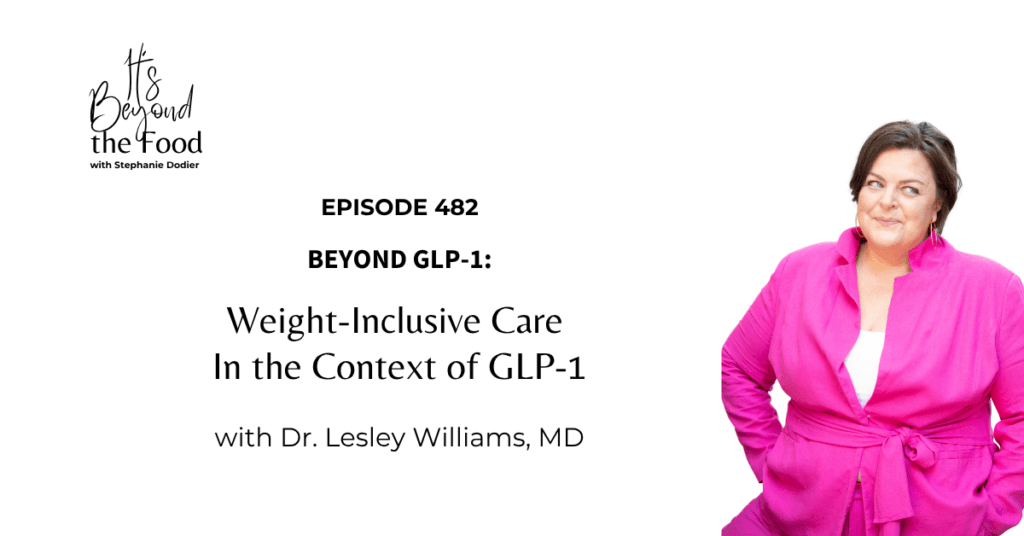


Right as weight-inclusive medicine started gaining real ground, GLP-1 walked in and put BMI back at the center of the conversation. Dr. Lesley Williams is a board-certified family medicine physician, eating disorder specialist, and certified menopause practitioner. She practices weight-inclusive care inside a system that increasingly runs on this class of medication.
In this conversation, we talk about what actually changes when a weight-neutral practitioner sits across from a patient who wants a prescription. We talk about the shared decision-making framework she uses, the assessment gap most prescribers skip, why rapport has to come before advocacy, and where she thinks this is all going over the next five to ten years.
Episode Highlights & Timeline
[1:06] What she has seen change in her practice over the last four to five years of the GLP-1 era
[5:21] Is this a pendulum, or is this the new status quo
[7:35] The early adopters who are already starting to come off the medication
[16:21] Her shared decision-making framework for GLP-1 and intentional weight loss
[24:11] Why fortifying a patient before medication changes the long-term outcome
[42:03] The coming wave: GLP-1 tied to menopause, PCOS, and prevention
[46:36] Her five-to-ten-year outlook for weight-inclusive care
Mentioned in the show:
Beyond GLP-1 Expert Podcast Series
Non-Diet Client Assessment Tool
Non-Diet Coaching Certification Waitlist
Full Episode Transcript
This transcript was auto-generated and lightly edited for clarity.
Click to expand the full transcript
Can a doctor be weight-neutral and still prescribe or support GLP-1 medications?
Yes. Weight-neutral or weight-inclusive medicine is a framework for how a practitioner approaches a patient’s health, not a rule that forbids specific medications. Physicians who practice weight-inclusive care can and do support patients who choose GLP-1 medications, while still centering the patient’s overall health goals rather than a number on a scale.
Dr. Lesley Williams, a board-certified family medicine physician and eating disorder specialist, describes this as finding a fine line rather than picking a side. In practice, this looks like a shared decision-making conversation before any prescription: understanding why the patient wants the medication, reviewing their history with food, weight, and body image, screening for risk factors like prior disordered eating, and being transparent about likely outcomes, including the fact that weight regain after stopping the medication is common, not rare.
A weight-inclusive approach also means the practitioner does not require the patient to focus on weight to receive good care. If a patient’s stated goal has nothing to do with weight, weight does not enter the conversation unless the patient raises it. If a patient is weight-centric, the practitioner can still engage with that goal honestly, without abandoning a weight-neutral lens in the rest of the relationship.
The alternative to a weight-inclusive practitioner engaging with GLP-1 is not neutral. Patients who cannot find this kind of care from a weight-neutral provider often seek it elsewhere, from providers with no training in weight-inclusive or eating-disorder-informed care, which can result in more harm, not less.
Transcript
[00:00:02] Stephanie: Welcome to the podcast, Leslie.
[00:00:05] Lesley: Thank you. Thanks for having me.
[00:00:07] Stephanie: Uh, very excited. So Dr. Leslie Williams is an eating disorder specialist, board-certified family medicine physician, and certified menopause practitioner, and I heard her speak at a conference on weight inclusive or weight neutrality medicine, and I just fell in love with her, and I had to bring her onto the podcast to share her point of view with all of you, and we’re gonna talk about weight inclusivity in clinical care in the GLP era.
[00:00:42] Stephanie: So with that in mind, I’m gonna open up this conversation, and we’ll see where we go with this, but you do practice in-clinic weight inclusive medicine, uh, in the system and outside of the system, and you have a vision of what clinical care look like right now and a practical view on it that I wanna share.
[00:01:06] Stephanie: So what have you seen change? ‘Cause you’ve been in practice for a few years. What have you seen change for the last four to five years when GLP era came in and started to hearing it from your patients? What has been your big observation in your practice of changes?
[00:01:26] Lesley: That’s a great question. I feel like before the era of GLP-1s, we were on the cusp of getting more buy-in for weight inclusive care.
[00:01:36] Lesley: You know, like, the, um, American Medical Association had come out saying that we need to really decentralize weight and BMI, talking about some of the, you know, systemic harms for certain groups in over-focusing on BMI. So I was feeling very optimistic that we were gonna see some real change, and right as that kind of wave was happening, um, GLP-1s came on the scene.
[00:02:04] Lesley: And so then it felt like a huge step backwards in terms of now in order to qualify for the medication and so forth, um, BMI and weight was being recentralized because that was one of the main criteria for, um, you know, qualification for the medication. In addition to that, I feel like we were s- in a season of being more, you know, weight neutral, body acceptance, and now in the era of GLP-1s, I feel- like every person on the street felt that they were a, an authority, um, in terms of someone else’s weight and shape, and wanted to give advice about these new medications that you need to try.
[00:02:53] Lesley: So I feel like it was kind of this perfect storm of like we were in the midst of shifting the tides, and then the medications came, and now it almost felt like, you know, there’s just an increased focus on weight that I was hoping we were kind of moving past.
[00:03:13] Stephanie: And are you seeing that in your patients’ experience of weight stigma, how they talk to you about their weight, about their body, about their health and their weight?
[00:03:25] Stephanie: Like, are you seeing it impacting them as well?
[00:03:29] Lesley: Definitely. I feel like patients, um, are, are feeling that push and pull. Like, even those that had gotten to a point where they were engaging in healthy lifestyle and, you know, they were accepting where their body was, but they may have been at a higher, um, weight.
[00:03:45] Lesley: It’s like now everywhere you turn, they’re getting this message that, um, you know, you need to take this medication in order to reduce your size. And, and, um, so I think that patients come in oftentimes needing reassurance. Or what I also see a lot of times, especially being in, like, a tertiary care type setting, is that maybe my patients and I have gotten to a point where they are doing really well and really happy with where they’re at, but one of their specialists is saying, “You need to go back to your primary care doctor and ask them to put you on this medication.”
[00:04:21] Lesley: And so, um, so I definitely feel like par- patients are somewhat caught in the middle at times. And, um, so, you know, they are impacted by, um, weight stigma because again, now there is more and more conversation.
[00:04:40] Stephanie: Yeah. I’m seeing the exact same thing. Um, like even for me living in a, in a larger body, like I’ve been confronted with those specialists wanting to prescribe me…
[00:04:53] Stephanie: In Canada, we have a bit different system. The specialists, uh, do prescribe it, but we’re seeing the same thing in Canada, and talking to people in Europe, we’re seeing the same thing. And one of the question I’m gonna ask you later, and, and perhaps we’ll go into that right now, I think it’d be the right moment for this, do you see it as status quo right now, or do you see that there could be a coming back to where we were?
[00:05:21] Stephanie: Like, is it a pendulum swinging? Hmm. What do you see happening? You know,
[00:05:27] Lesley: that’s an excellent question. I do, in most things in medicine, I feel like the pendulum swings back and forth. Yes. I don’t think we’re quite at the stage where it’s gonna shift back. So what I’m seeing in practice is that as, in terms of indications for this class of medications, it’s expanding.
[00:05:48] Lesley: The, um- Types and forms of the medication are expanding, and so I think that there’s still more change to come. I do see, though, with patients who have maybe gone on a trial of GLP-1s, that they are coming back saying, “Hey, you know, I did that medicine. I didn’t really love it for a variety of different reasons, and I want us to chat about other non-medication ways for me to maintain my health.”
[00:06:21] Lesley: So I think in terms of that season, we’re starting to see that wave of patients that are like, “Yeah, you know, I kind of jumped into the frenzy, but I’m… You know, it’s just not my thing.” Um, and I hear a variety of different reasons. I, I hear a lot of patients… There’s, you know, food is pleasure for many of us.
[00:06:38] Lesley: You know, we enjoy food. It’s something that we look forward to. It’s something that we can gather around, and I, I hear a lot of patients telling me sometimes, “You know, it was just very disconcerting for my, um, appetite to go away, for my pleasure of food to go away. It was something that I look forward to.”
[00:06:57] Lesley: I, I have, you know, um, a patient who’s from Italy, it’s just like food is life and, you know, just… And so for that to go away, for some patients, is disconcerting. And so they’re coming back saying, “You know, I did it. I lost the weight, but I really did not enjoy that aspect of the experience, and so I would like to, you know, move away from the medication and look at other…”
[00:07:22] Lesley: So I’m seeing different, um… You know, I am seeing that, but it’s not probably the same numbers as I’m seeing people coming in requesting the medication. So I do think there’s potential for change in the future.
[00:07:35] Stephanie: Yeah. The, the early adopter bell curve, like the people- Mm … who’ve been in it at the beginning, they’re coming off of it for all the reason in the world, and these are the people we’re starting, you’re starting to see in your practice.
[00:07:46] Stephanie: Mm-hmm. Okay. Let’s talk about weight inclusive approach. Let’s set the tone because you shared that in your keynote, and I think that was brilliant. Like, walk me through what it means for you to practice weight inclusive care, what it actually look like in practice. without GLP-1, like just a basic approach to- Yeah
[00:08:08] Stephanie: weight-inclusive care. And then we’ll bring in GLP-1 after that in the conversation. Exactly.
[00:08:13] Lesley: So I would say my basic approach to weight-inclusive care is that I really, um, like to see every patient from a holistic view, and I want to center their health goals. So regardless of, you know, body shape, size, I- we’re gonna sit down and talk about what are your health goals, um, you know, what things do you feel like are going well, and how can we optimize that?
[00:08:38] Lesley: In the same vein, I have patients that maybe they feel that their health is great, but if we’re looking at numbers-wise, be it their blood pressure, their cholesterol, some other aspects of their health that maybe aren’t optimized, we’re gonna look at those things. Like, what, where are some areas from a preventative health standpoint that I could maybe, um, partner with you to kinda optimize your health?
[00:09:03] Lesley: So that’s kinda how I think of, you know, that weight-inclusive care in general, and I don’t really enter weight into the equation unless it is something that the patient states on their list of goals that it’s something that they want to address. Um, so that’s usually what I try to do, is kinda set the tone for what are those health goals that we’re gonna work towards together, um, and how can we look at steps to achieve that, that are outside of weight?
[00:09:33] Lesley: ‘Cause I often tell patients, you know, like let’s say for instance we’re trying to get their LDL cholesterol down. There are so many things that we can do to address that, that I don’t really… You know, weight doesn’t need to come into the picture. Um, and so I don’t, you know, I don’t really talk about it, like I said, unless a patient brings it up.
[00:09:51] Stephanie: And I’m curious because you are in general population, so you have people from all walks of life, not necessarily people coming in to look for weight-inclusive care. How people react, how does your patient react not being engaged with weight as part of their goal for their health?
[00:10:11] Lesley: It’s really interesting.
[00:10:12] Lesley: I think people who have had a prior experience with weight stigma in healthcare find it very refreshing. They’re oftentimes surprised and even a little, you know, kind of, I don’t know, disoriented by having- Yes … an experience with a healthcare provider that doesn’t focus on that. So those people who have had negative experiences, um, find it refreshing.
[00:10:37] Lesley: I think that people who are very used to that being centralized and maybe, um- It, that can also be disconcerting. They feel like, you know, “What do you mean we’re not gonna talk about my weight? Everyone’s been talking about my weight my entire life. That’s all people have ever talked about.” And so I think that that’s the minority of patients, but it has happened.
[00:11:02] Lesley: I’ve had a patient be very, very upset with me, um, because I did not want to focus on her weight. She felt like She wasn’t being cared for because I was not focusing on her weight in the ways that she was accustomed to. And so when we had that conversation about what are some other ways that we can achieve your goals, ’cause I did, I asked her what her goals were.
[00:11:30] Lesley: Many of the things that she listed, playing with her kids, you know, doing these other things, I felt there was potential to achieve that without focusing on weight. But, um, that was… She didn’t enjoy that. She felt like she wanted to focus on weight and really wanted to move towards more aggressive interventions, like surgical intervention and so forth, and she felt like by not doing that, I was not, um, really prioritizing her health.
[00:11:59] Lesley: And so I have to walk that line with patients of, like, finding out from them what is their priority, and despite my overall weight inclusive approach to medicine, if they feel that weight is something that is very, very important to them, then I need to enter that into the conversation if I’m going to be helping them from a patient-centered approach.
[00:12:27] Lesley: But all along, still kind of sprinkling in the value of weight inclusive care, because I do think that people will come around, right? Even if they come in very much like, “I have to lose X amount of pounds, and I’ve gotta do it by this date,” and blah, blah, blah. If you just kind of gently sprinkle in the idea that life could still be amazing if that number doesn’t change at all, um, and at some point they might hear that.
[00:13:01] Lesley: But I think if I come too hard with, like, the, “We’re not gonna talk about weight. Don’t ever…” You know, like, if I come too hard and that is a patient’s priority, then I lose them, right? Because they feel like I am not partnering with them towards their health goals, and then I don’t have that opportunity in the future to readdress the conversation.
[00:13:28] Stephanie: And that, that is the piece that many practitioner struggle with, is, like, that point where it’s, “Okay, my values are weight inclusive and weight neutrality. Patients is weight centric. How do we negotiate the relationship?” And that is a really present struggle right now. So any thoughts, any advice you may have for the people listening to this will be very welcome, as someone who practice that every day.
[00:14:00] Lesley: Absolutely. I think the way that I try to reframe it is I think in, you know, parallel context of, like, if I had a patient that is still a smoker in 2026, despite all of the data that that is not, um, you know, beneficial for their health, am I going to kind of take this hard line of, you know, constantly, um, talking about how negative, you know, the smoking is for their health and, and lose that rapport with the patient, or am I going to take this patient from a holistic perspective, maybe, you know, sprinkle in every now and again, check in to see how ready they are to, you know, reassess, um, smoking cessation as a goal, and then be there for them when, in the future, they might…
[00:14:53] Lesley: a life circumstance might happen where they’re more open to exploring that. So I kinda, like, keep a parallel like that in my mind, and I think it helps me to walk that fine line. ‘Cause I- ’cause we do it in so many other aspects of medicine, but I think especially for those of us who have been real advocates for weight inclusive care, it can sometimes be challenging, um, when patients’ goals are not aligned with that.
[00:15:22] Stephanie: And what I hear you say is that you put rapport, the quality of the rapport, as a priority over, one should say, your own values, your own belief and practice. If that doesn’t match, then the rapport becomes the most priority in the relationship. Would that be a right way of saying what-
[00:15:45] Lesley: I, absolutely, because I, I’ve seen so many times when rapport and trust-
[00:15:52] Stephanie: Mm-hmm
[00:15:53] Lesley: will make patients reconsider sometimes their health approach in the future once you’ve had the opportunity. But if you- lose them early because you guys are not aligned, then they never get the benefit and they’re gonna end up, you know, maybe going to someone else who doesn’t have that same, um, perspective.
[00:16:21] Stephanie: Yeah. In your presentation, um, you talk about a shared decision-making framework that you use with patient, and you put it in the context of wanting GLP-1, but I think we can broaden it to wanting weight loss, like- Mm-hmm … intentional weight loss. Can you walk us through that framework and- Sure … what an actual conversation would sound like or look like?
[00:16:48] Lesley: Absolutely. So if I have a patient coming in requesting, um, weight loss, I usually start with the why. Why is that a goal for you? To, for me to kind of get some context as to what their motivation is. And then I’ll maybe talk about their history. What was their history been- With weight, shape, food, really get a little bit granular in terms of looking for risk factors of prior eating disorder, prior weight-based stigma, you know, things like that that are gonna definitely make them vulnerable to, um, maybe some disordered eating and so forth.
[00:17:30] Lesley: Um, so I will walk them through that. I will talk about some of the different options that are available, and we’ll talk about the risks versus benefits. Um, if I think that a patient falls into a vulnerable category, so someone who struggled their entire life, um, with their weight, has had a history of weight-based stigma and so forth, and I’m concerned that if we were to start on this journey, it could be potentially, um, have a negative impact, um, then I’m gonna say, “Hey, before we, you know, start looking at a medication or whatever their, their ultimate goal is, I really think we need to get some more team members involved, some more support involved.”
[00:18:24] Lesley: So that might come in the form of a therapist, a dietician, you know, who else do we maybe need to get, um, involved in your team so that we can fortify you before we embark on this journey. And then I also talk with them about red flags. Like, if we elect to go this route, these are some of the things that I’m concerned about.
[00:18:50] Lesley: And then we also talk about goals. And I will talk very frankly, especially when patients are very weight-centric, um, I will try and look objectively at their labs, at their vital signs, find another non-weight-based thing that we can look to to monitor, and then I will tell them, and then I will ask them what is their weight goal.
[00:19:11] Lesley: And sometimes people’s goals are to achieve a weight that they haven’t been at since- Mm-hmm … you know, high school, you know? And so we’ll talk about, um, you know, how realistic that is and if that is really a health goal or if that is, you know, there’s something else to that. And then I will say, “Hey, you know, I’m gonna be monitoring, let’s just say, your blood pressures or your lipids or whatever.
[00:19:36] Lesley: And once those start getting consistently in range because of these different lifestyle things that we’ve talked about, that’s gonna maybe be a time for us to talk about maybe we’re at a good place for maintenance, but you may not be ready for that if you have this unrealistic goal of weighing 98 pounds like you- when you were a freshman in high school or something, you know, that’s just, like, not realistic, that you haven’t been able to maintain as an adult.
[00:20:02] Lesley: So I wanna talk about that early, because I don’t want us to wait until we get to that point and have that conversation. So I want us to renegotiate a time in the future, um, when we can talk about what does maintenance therapy look like, what does the next phase look like? I want us to talk about that earlier rather than later, um, so that it’s not a contentious conversation once we arrive at that point
[00:20:33] Stephanie: So it’s about having the conver- to broaden the conversation to the why, the history- Mm-hmm
[00:20:39] Stephanie: and also heard you say about the assessment, right, of the e- potential eating disorder, disordered eating behavior. ‘Cause I’ve had a conversation with, uh, many practitioner, and that’s a big gap right now. Prior to- Mm … specifically prescription of GLP-1, there’s no required assessments of the- Right
[00:20:59] Stephanie: individual, which is a big problem, which I’m sure will become even more predominant in years to come. But I heard you say assessing.
[00:21:07] Lesley: Yes. Which- And that’s one thing I definitely want to do, and I’ve been trying to encourage more of my colleagues, like if you smell anything that sounds like there might be, you know, if you’re not comfortable, send them to me.
[00:21:23] Lesley: I’m happy to assess them and have that conversation, and let’s figure out, like even if they still wanna move forward- Mm … how can we do that in a way that is most beneficial to them? So what will happen sometimes, and maybe it’s a little bit of a negotiation, right? A patient is highly motivated to start a GLP-1, but yet they have this history of weight-based stigma, they have this history of disordered eating.
[00:21:48] Lesley: It’s maybe not, um, significantly prevalent right now, but again, they’re at risk. So before I’m gonna even, you know, prescribe or recommend that their condition, that their practitioner consider prescribing, I’m gonna say we need to get these team members in place. And so patients are a little bit more motivated to do that work because, again, in their mind, they wanna get that medication, but ultimately we’re giving them what they need to be successful for the long term, because I talk to them all the time.
[00:22:21] Lesley: Let’s say we prescribe the medicine, but we’ve never addressed maybe some underlying eating issues, and for whatever reason, the medicine then goes away, you know? And then we’re still stuck with that- aftermath, if you will, and we haven’t addressed all of those issues. So, um, so I definitely get a little bit more buy-in.
[00:22:42] Lesley: I think, um, when, you know, starting the medications is not off the table, it may still be a carrot, but let’s make sure we do this groundwork ahead of time. Okay. And I’ve seen it be successful. I’ve seen it be successful.
[00:22:55] Stephanie: In what way successful?
[00:22:58] Lesley: I would say I’ve had patients that come in and they are open to the process.
[00:23:03] Lesley: They wanna be successful, especially those people who’ve maybe stru- they’ve, you know, kind of yo-yo dieted in the past, so they want a plan that is going to be sustainable. And so once we get those team members, I can think of one patient off the top of my head. She started seeing a therapist. She started working with a dietician.
[00:23:22] Lesley: Um, we did some exercise consultation to work on some opportunities for her to do movement, then we started the medication. Then she was able to have some, you know, modest weight loss, and then has been able to maintain. And again, she’s maintaining at, you know, not a very, very low BMI. She’s maintaining at a moderate BMI.
[00:23:44] Lesley: She’s doing all these things. I mean, doing amazing. Um, but I don’t know that we would have had that same success had someone just knee-jerk started her on the medication at the beginning without identifying all of the struggles and getting the right people in place to fortify her, and to have that conversation early about what our end goal looks like and what a maintenance phase looks like.
[00:24:07] Lesley: So, um, so yeah. So I’ve seen some success with that.
[00:24:11] Stephanie: I love the word fortifying her. I heard you say that two to three time right now, which is basically the behavioral change, right? The around it, the mental, the emotional, and then the health-promoting behavior outside of food and weight. What else can she integrate in really bringing a holistic lifestyle to the patients?
[00:24:32] Lesley: Absolutely. And the thing that was so, this one case in particular, was so rewarding is that she stopped weighing herself.
[00:24:40] Stephanie: Oh.
[00:24:41] Lesley: And that was huge, because that had been so much of her kind of like daily marker of, you know, success or failure. And for her to just stop weighing herself completely and really kind of trust her body was just incredibly rewarding.
[00:24:59] Lesley: Yeah.
[00:25:00] Stephanie: Life-changing. And imagine, like from a mental and emotional, like what it did to her anxiety level or like emotional stability of not having this thing every morning. Like- That has long-term repercussion for the rest of her life. Right. I’m curious, do you have, once you’ve made that decision framework with the patient, and one tool I always recommend to practitioner is the free guide from, I think it’s, I’m gonna mispronounce it, but the Medical Student for Size Inclusive Medicine.
[00:25:29] Stephanie: Yes. It’s a free PDF. Yes, and I think they- It’s available to all of us … just
[00:25:32] Lesley: updated it. I
[00:25:33] Stephanie: think they
[00:25:34] Lesley: just- Yes … updated it, yeah.
[00:25:35] Stephanie: Is that what you use with an informed consent with patient, or you use something else?
[00:25:40] Lesley: No, I don’t. I used to- Yeah … print that out. Now, I think I have this conversation so much, I kind of have it just, like, right off the top of my head.
[00:25:51] Lesley: I can almost do it in my sleep. So it’s more of a verbal conversation that we have now. Um, you know, in a rare case where I feel like someone needs something written, that is an excellent resource, and I definitely recommend it. But, um, typically it’s more of a verbal, you know, conversation that we have.
[00:26:14] Stephanie: I’m curious, since you have so much experience in this, when you have that conversation with folks and you obviously mention them that weight regain is most likely the outcome, do they know that prior to requesting it, or does that still come as a surprise to people?
[00:26:32] Lesley: I think it still comes as a surprise to some people because, um, but I feel like more and more in the popular media they’re discussing the fact that- Yeah
[00:26:42] Lesley: weight regain is a possibility when it comes to GLP-1 specifically. And so I always tell patients about that. And it’s interesting ’cause some of them still believe I’m gonna be that minority that can go on it- The 1% … for a period of time and stop it and maintain it. So they still, you know, there’s some people that still firmly believe that even though I will, you know, educate them that that is the exception and not the rule.
[00:27:07] Lesley: And there, um, are also people that say, “Well, I would, I would never stop the medication,” and they don’t necessarily understand the conditions outside of their control that may require them to. So we talk about things like insurance coverage and, you know, different things that could impact your ability to obtain the medication that are outside of your desire to obtain the medication.
[00:27:33] Lesley: And so I just, um, warn them about that as well. I have seen insurance coverage expanding but, you know, even as early as 12 months ago, you know, there were a lot of insurances that had lifetime maxes, that had, you know, complete exclusion of that entire class of medications. You know, so I just tell them there are things that can happen in terms of access that are outside of your control, so you need to be aware of what that may look like if you are not able to obtain the medication.
[00:28:05] Stephanie: Do you have any, I’m sure you do, but do you have any condition, symptoms, cases where you prescribe GLP-1 for what it was originally intended for? Like in this case, we know it’s approved for diabetes. Like do you have- Oh, diabetes … diabetes. I don’t think, uh, in Canada it’s not, um, it’s not, uh, approved for anything else.
[00:28:27] Stephanie: I’m not sure in the State. I know diabetes is approved, but is there any other condition by where you’re using the medication for the intended approved purpose outside of weight loss?
[00:28:36] Lesley: So, um, diabetes for sure. There is an FDA indication for sleep apnea as well. There, um- Is some emerging data for, um, cardiovascular disease, and so that is an indication that I think I have gotten it approved for.
[00:28:57] Lesley: And then just recently, I have a patient with, um, congenital renovascular disease, and their nephrologist was, um, advocating for that, and I believe he got it approved for that. So, um, but in terms of FDA-approved, um, the ones that I’ve had success with are the sleep apnea specifically and, um, cardiovascular disease.
[00:29:24] Stephanie: And the mechanism of the GLP-1, for an example, sleep apnea, is it of the outcome of weight loss or just by the mechanism of GLP-1 helping directly with sleep apnea?
[00:29:38] Lesley: I believe it’s by the, you know, as a result of the weight loss. And so there’s certain, um, criteria in terms of, like, their AHI score index and things like that, and you have to go back in their sleep studies.
[00:29:54] Lesley: There aren’t- I have tried to get it approved for sleep apnea for a number of people, and it is the minority where their insurance will, um, approve it for that indication. But that is one of the FDA-approved indications.
[00:30:12] Stephanie: Okay. Um, let’s talk about, um, w- internally within our profession, um, there’s a lot of pressure for people to look at GLP-1, and I, I’ll call it pick a side, right?
[00:30:28] Stephanie: It’s the very binary either you are a GLP-1 or you’re not. And even me, that’s why I wanted you on the podcast because you’re the first one who’s willing to have a neutral conversation. Most people are afraid of what their peers will think because they’re not… They’re pro GLP-1. Like, it’s very binary.
[00:30:49] Lesley: Yes.
[00:30:50] Stephanie: What are your thoughts on that?
[00:30:52] Lesley: You know, I, I agree that that is the case, and I think that even before I gave that recent keynote, there was a lot of feedback, concern, interest in what I was gonna say and how I was gonna approach it, and how people were going to perceive it. And personally, how I navigate life personally and professionally is that I try to be fully transparent, right?
[00:31:23] Lesley: I just try to… And I just believe there is opportunity to operate in the gray. I do not think, uh, you can practice medicine in 2026 and have a hard line against prescribing GLP-1s just because they are becoming so prevalent. Patients are educated about them. The indications are increasing. You know, if you work in a tertiary medical care center, there’s more and more, um, encouragement from your specialty colleagues to consider it.
[00:31:57] Lesley: So I just think taking that hard line right now is, is not possible unless you practice in a practice where you have just elected, “I’m not going to do that,” and you have, um, put that forth in terms of patient education, and then you will attract patients that are interested in that, um, that approach. But in general, if you’re working in a collaborative care model, it’s really, really challenging.
[00:32:27] Lesley: And so I’ve had a lot of sleepless nights trying to figure out how this feels very, like, against what I’ve been advocating for so long. How do I find that middle of the road? And I’ll be honest, my patients have been- The, my best teachers because I think seeing them and trying to really support them through this new season of GLP-1s has motivated me to kind of figure out how can I, how can I, um, embody both spaces.
[00:33:01] Lesley: And so that is, that’s really how I’ve kind of come to this approach.
[00:33:06] Stephanie: Have you had negative pushback from people internally within our industry professionals?
[00:33:12] Lesley: I think the most pushback is probably, um, just from- A lot of the just weight inclusive advocacy groups. Yeah. But I think it’s not so much from medical providers.
[00:33:31] Lesley: I think if you are currently practicing medicine, you recognize- Yeah … how pretty much impossible it is to, to not, um, be engaged with these class of medications at all. Um, but I think people who just aren’t as, um, embedded in the current healthcare system maybe don’t have as much of an awareness and feel that it’s a lot easier to, um, exclude, um, than it might be in practical, in a practical sense.
[00:34:08] Stephanie: And I think it also gives you more leverage to impact the future when you can be in that space where we can discuss GLP-1 for the nature and the mechanism of the GLP-1 in itself, just like it did give great result with type 2 diabetes, and help people detach GLP-1 from weight loss just for the nature of the medication itself and what it can do.
[00:34:33] Stephanie: Right.
[00:34:33] Lesley: Interesting. ‘Cause even it was interesting when I had given the keynote, I, I think one of my slides made a mention of, um, advocacy for GLP-1 medications, and someone got really upset and inflamed about that, and I’m like, “I’m talking about patients that have insurance and have diabetes that can’t access these medicines.”
[00:34:58] Lesley: And I feel like that is also a real disservice because we know in terms of diabetes management, they have been life-changing for some patients that have been struggling for a really long time. And I feel strongly that if there’s a medication out there that is that beneficial, regardless of your insurance coverage, um, your socioeconomic status, you should have access to that.
[00:35:24] Lesley: And there’s just been so much focus on this class of medications in terms of weight loss, and we forget that there are people out there that, you know, have diabetes that it’s not even on the table, and it, it feels like such a disservice where we’re talking about, “Hey, there’s this new class of medications.
[00:35:43] Lesley: Look at all of these amazing benefits, and only this group of people is gonna have access, and the rest of you, you know, keep struggling with, um, your challenges with insulin.”
[00:35:57] Stephanie: Yeah, and it’s also, we can talk about, and maybe I’ll have your thoughts on that, it’s the whole dosing issue, right? GLP-1 a low dose is what it was researched, I think, close to 15 or 20 years before it was even thought to be a weight loss medication, and that’s when the dosing started to go completely wild in order to get to the weight loss.
[00:36:20] Stephanie: Yeah. And I think, and, and I’m not a prescriber, but I’m pretty sure we can prescribe GLP-1 a low dose to get the beneficial effect with type 2 diabetes without inducing weight loss. Am I correct in my way of thinking here? Yeah.
[00:36:33] Lesley: Absolutely, and I think that’s one of my, um, that is accurate, and I definitely have a pet peeve when it comes to my patients that I am treating them with a GLP-1 for their diabetes.
[00:36:46] Lesley: They have excellent blood sugar control, and they come in and tell me, “My pharmacist said that you need to increase the dose.” Your pharmacist does not have access to your blood sugars. They don’t know anything about you other than that you came to pick up this prescription, and I find that very upsetting that they would make a recommendation to you about the dosing of your medication.
[00:37:12] Lesley: I- the only thing they could have been basing that on is, you know, how that person looks. Um, and so that, I see a lot of that trend, is like, you know, I have these diabetics that are well-controlled, and this person, that person, the pharmacist, the person at the bus stop told them, “You need to ask your doctor about being on a higher dose.”
[00:37:35] Stephanie: Yeah, just to induce the weight loss, which was not the reason why it was prescribed in the first place. And I think that’s the dialogue that’s not being, we need to have, and we need to push through so we can move away from just GLP-1 for weight loss, but GLP-1 for what it was discovered and intended to- Originally.
[00:37:56] Stephanie: Let’s talk… I wanna take this opportunity since I have you, I’m gonna shift the conversation a little bit to menopause and midlife, because that’s one of your specialty. Um, how do you see, or what are you hearing, seeing, observing with regards to perimenopause, menopause, and GLP-1? Let’s open the field here, and we’ll go deeper if we need to.
[00:38:18] Lesley: Absolutely. So currently, that is not a, um, kind of FDA-approved indication for prescribing, but I am seeing it increasingly in practice, where patients during that perimenopausal period, we know that there’s, um, weight gain that happens as the body is adjusting to, for instance, decreased estrogen levels, and a lot of it has to do with weight distribution changes as well.
[00:38:46] Lesley: Women tend to then accumulate a little bit more adiposity in the midsection, in areas that they maybe had not previously, and it can be very distressing. I mean, there’s so many, um, lovely things that go along with this, um, kind of midlife season, and then you add to it your body changing despite your best efforts, and it can be very upsetting.
[00:39:13] Lesley: And so there has been some research that, um, suggests that, potentially, you know, use of GLP-1s with or without, hormone therapy may be of benefit to help kind of mitigate some of those, um, body changes. I myself am not prescribing in that manner if patients don’t have other, you know, some other type of health indication.
[00:39:38] Lesley: But I am seeing that more and more, where my patients in midlife are like, “Hey, I went and saw this practitioner, that practitioner. They have me on a low-dose GLP-1.” And, um, patients are very, um, happy with the outcome. I think that I really try to get patients just to be open and honest, because I think there’s a lot of- Um, maybe trepidation about being honest when you’re getting a GLP-1 from someone other than your medical provider.
[00:40:13] Lesley: And- Hmm … I do wanna educate patients about, you know, the risks versus benefits, but I definitely wanna know because it might be impacting their health in some other way. So I try to be neutral, um, e- even if I don’t agree with, um, how they’re getting it or why they’re getting it or whatever. I try to be neutral because I want to kinda make sure that they’re keeping the lines of communication open and letting me know, um, so that I have that information when it comes to medical decision-making.
[00:40:46] Stephanie: I think that’s a very important… Like, I never thought about that, but that’s… If you’re not neutral in your conversation, patient will not disclose that.
[00:40:56] Lesley: Correct. And I’ve had that experience previously where patients do not disclose, um, you know, and then they will come in for like, for a while when more places were doing the compounded GLP-1s- Yeah
[00:41:12] Lesley: they were often kind of, um, navigating that by adding B12, large, um, amounts of B12. And then I had a patient come in with some symptoms consistent with, um, B12 toxicity. So I needed her to let me know what was going on- Oh … so that I could kind of pinpoint, um, where, you know, where that was coming from. Um, and I don’t know that she would have told me otherwise, and she had been on the medication for a while.
[00:41:41] Lesley: So again, I just try to be neutral so that they will let me know, but I also let them know that, I try to go by the book in terms of indications for use. And if you fall outside of that, this isn’t a place where you’re gonna be able to get that medication. But patients are aware that they can call online, go wherever, and, and get it if they elect to.
[00:42:03] Stephanie: And one thing I, this is my own perspective, and I’d love to hear your thought. The, the next couple years, maybe next five years, will be this broadening of association of medical condition to GLP-1. Like, the last few months it’s been cancer. Now, this perhaps association with perimenopause, menopause symptom.
[00:42:21] Stephanie: Like, we’re gonna see an attempt by the manufacturer to connect their medication with all the potential conditions. Yeah. Is that what you’re seeing- Yes … coming to us?
[00:42:33] Lesley: Yes, absolutely. I think PCOS, um, metabolic associated steatotic liver disease. I mean, there’s gonna be more and more and more indications.
[00:42:43] Lesley: And what’s interesting is that because patients see that forecast of more indications, I’m having more patients come in and ask me, “Should I just start this medication as a prevention? That I think I should just go on this now because I have a family history of high cholesterol,” or I have whatever.
[00:43:05] Lesley: Again, interesting kind of, um, take on why they feel like they… “So I feel like I should just start it now because, you know, it seems to be good for everything, and then I can, you know, be kind of ahead of the game in terms of,” um prevention of medical comorbidity. So that’s been an interesting conversation I’ve been having recently.
[00:43:29] Stephanie: Which obviously, just for anybody, there’s no recommendation of doing that in any way, shape, or form, but that’s the way people, non-ed- non-medical professional people think.
[00:43:38] Lesley: Yes. Absolutely.
[00:43:40] Stephanie: Right? One other thing, and this is, like, very timely, um, and w- we’re closing to the end of the interview, but I wanted to put this forward with you.
[00:43:48] Stephanie: Uh, I’ve heard two people talk to me about GLP-1, and it was actually men with testosterone. Apparently, there’s a large study that was presented or came out about, like, 50% of the population presen- m- male population particularly, uh, presenting with low testosterone, and then connecting that with obesity, and therefore GLP-1.
[00:44:12] Stephanie: So the logic was take the GLP-1 to reduce the weight and increase your testosterone. Have you seen, heard, encountered that? I haven’t
[00:44:22] Lesley: seen that yet, but I do know that there is that association, um, in terms of testosterone levels, so I wouldn’t be surprised. What I have had a couple of male patients describe, though, is a decreased libido on the medications because just like we talked- Mm
[00:44:38] Lesley: about previously in terms of kind of decreased, um- Sure … appetite and pleasure centers, you know, um, I’ve had a couple patients that did not like that. They, they were like, “I just- Ah … I don’t even think about it. I’m not interested in it.” Um, which is interesting. So I don’t… Again, that’s just anecdotal. Um, but it’s…
[00:45:00] Lesley: They kind of describe it in the same way as those that describe it really taking away their pleasure for food. Um, and I think that’s why they’re looking at it in that substance abuse space as well because there’s been some, um, you know, indication that it helps in terms of decreasing, um, substance use.
[00:45:18] Lesley: So I think– So it’ll be interesting to see how things emerge.
[00:45:23] Stephanie: Yeah. Two question before we close. Number one, if you had one thing you wish every weight-neutral practitioner, prescriber understood as they’re walking into a conversation with GLP-1 with their patient, what would it be?
[00:45:42] Lesley: Wow. I think that one thing would be it is possible to maintain your, um, weight-neutral advocacy and still support patients that are interested in GLP-1 therapy.
[00:45:58] Lesley: I think that those two things can coexist. It takes some work in order to kind of find that fine line that you wanna walk with patients, but I think it is possible, and I think that patients will benefit from more people feeling comfortable, um, in that space because I feel like the alternative is that patients will then go to people who don’t understand those principles of weight-neutral or weight inclusive care, and there could be even more harm.
[00:46:36] Stephanie: Yeah. If we look forward five to 10 years, where do you see weight inclusive, weight neutral health going considering GLP-1 era?
[00:46:50] Lesley: As we spoke about earlier, I think the pendulum swings. You know, I feel like whenever there’s a gold rush for a new medication, everyone’s very excited and, um, you know, quick to jump on the bandwagon, but I think the more and more and more people that are on the medications or have experience with them, we find that it’s not for everyone, right?
[00:47:14] Lesley: So it isn’t necessarily that holy grail. It may not be a fit for everyone, and there’s still gonna be a need, um, to care for patients that are not interested in this medication for what, this class of medications for whatever reason, and they still need exemplary medical care regardless of their weight, shape, or size.
[00:47:41] Lesley: And so, you know, I still think that there, it’s not that now that these medications are on the horizon, weight inclusive care goes out the window. I feel like it becomes more nuanced, um, more complex, more interesting maybe, because you have to kind of, integrate all of these different things, but I definitely think that there’s still, space and there’s gonna be constant evolution.
[00:48:05] Stephanie: And I’ll just close it with this. So far, research is showing us that intentional weight loss with GLP-1 has a very similar outcome as the traditional dieting with weight regain and working for a very small percentage, like the basic observation is still present with GLP-1, so people will regain the weight at some point, and they’re maybe then open to weight neutral approach to health.
[00:48:32] Lesley: Exactly. Exactly.
[00:48:34] Stephanie: Thank you for your time. It was a absolute pleasure speaking with you today.
[00:48:39] Lesley: Thank you. I enjoyed it.
[00:48:46] Stephanie: If you want to coach behaviors, not bodies, learn the mindset tools and the method that create real change. Join the waitlist for the next cohort of the Non-Diet Coaching Certification at stephaniedodier.com/waitlist. That’s where the real training begins, and I’ll see you on the other side, my sisters.