

In this Coach Corner episode, I answer two powerful questions from our community. I explore how we support clients who fear intuitive eating will harm their healthy eating habits. I also dive into how we address mobility concerns without reinforcing weight loss.
These questions open the door to deep coaching work. We look at emotional safety, performative eating, and the pendulum swing in intuitive eating. We also unpack weight neutral mobility support and how to guide clients back to trust and stability.
Episode Highlights & Timeline
[00:01] Why this fear of losing healthy eating habits shows up early in intuitive eating.
[02:03] Understanding the emotional attachment behind “eating healthy.”
[03:23] How mental restriction drives performative eating behaviors.
[06:25] Teaching the pendulum swing and why it matters in intuitive eating.
[08:28] Why gentle nutrition must wait until later in the process.
[09:54] How to explore mobility concerns without reinforcing weight loss.
[11:34] Weight neutral mobility and why mobility is not driven by weight.
Mentioned in the show:
Non-Diet Coaching Certification Waitlist
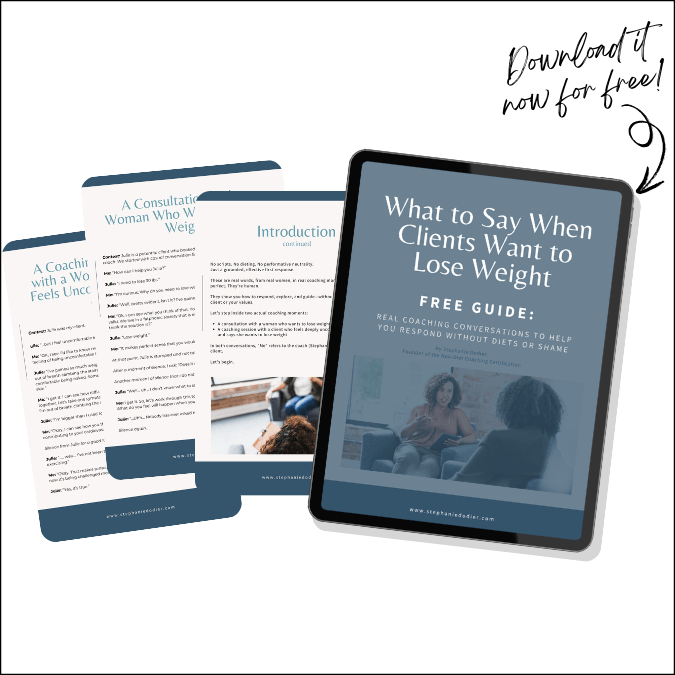
What To Say When Clients Want To Lose Weight Guide
Weight-Neutral Coaching Training
Full Episode Transcript
This transcript was auto-generated and lightly edited for clarity.
Click to expand the full transcript
How do I coach clients who fear intuitive eating means “eating unhealthy”?
To coach clients who fear intuitive eating means “eating unhealthy,” start by reframing the process. Early intuitive eating requires putting nutrition concerns on pause to reduce mental restriction. This pause does not lead to long-term unhealthy eating. Instead, it helps clients rebuild trust, regulate their nervous system, and break black-and-white thinking about food. Explore the emotional meaning they attach to “healthy eating,” unpack performative eating patterns, and explain the pendulum swing that happens as the body recovers from restriction. Once food becomes neutral and body cues stabilize, gentle nutrition becomes possible again—without fear or guilt.
[00:00:00] Stephanie: Welcome to The Beyond the Food Podcast, my sisters. I’m your host, Stephanie Dodier, and in today’s episode of Coach Corner series, we’re answering two question from our audience on the podcast.
[00:00:12] First, what do we do when during the process of intuitive eating, our client is afraid of “not eating healthy”. And second, how do we coach mobility concern with our client without reinforcing weight loss?
[00:00:32] Now, before we dive into answering these two questions, if you love these short coaching episode, you may wanna go grab the coach corner vault. It’s an on-demand library of over 50 mini training that I have done over the last, almost eight years now on mindset, body image, eating behavior, and even for you, some business coaching [00:01:00] mindset that I’ve done. Not as many as the food and help promoting behavior, but there is some gem in there you want to go grab, so you can go to the show note associated with this podcast episode or stephaniedodier.com/coach-corner. Ready? Let’s dive in.
[00:01:17] Question number one, how do I help a client who wants to eat intuitively but fear they’ll never choose healthy food again, this question is one of the most common concern that you’ll hear from your client as you’re beginning the process of intuitive eating, therefore something that you must possess as a non-diet health professional and know how to work with your client on this particular concern.
[00:01:50] And my answer is this, it is not about the food. It is beyond the food. It’s actually where the name of my company come [00:02:00] from. Because years ago when I faced this concern, when I went through with myself, as a health professional in practice nutritionist, I was doing the intuitive eating process and I was wanting to eat nothing but what I used to label as healthy eating, and that set me in this deep anxiety and thankfully, I had a coach who was able to walk me through it, and that’s what I’m gonna attempt to do over the next five minutes here. But obviously I’m gonna keep it high level, but to give you some key points for you to work with your clients.
[00:02:36] When someone start with intuitive eating, nutrition needs to be temporarily put on what we call the back burner. Not because nutrition doesn’t matter, but because at this point their brain and nervous system cannot engage with nutrition elements without slipping back into restriction. That’s [00:03:00] the cognitive distortion called black and white. It’s either all in or all out. And because diet culture has taught them that there’s absolutely some food that are healthy and there’s some food that are unhealthy, they want the healthy food because, and this is the key here.
[00:03:23] Because they have an emotional attachment, a survival need for them to eat the healthy food. And this is where the mindset and your ability to help them unpack what eating healthy means to them and about them. This is what we call mental restriction and circle of intuitive eating. It’s a stage of the 10 principle of intuitive eating where we need to unpack the mental restriction, and this is where client want to [00:04:00] continue to do what we call performative eating.
[00:04:03] So the reason why they want to eat “healthy,” is not because at this stage, they understand what healthy eating is, is because there’s a risk to who they are in this world, and that’s where the cognitive behavior coaching comes in and helps you as a coach help them understand that food choices has been associated with their safety, their worth, their self-esteem or even, and most people, their ability to control their weight and their weight means something to their safety into this world.
[00:04:43] That’s what we call performative eating is when we perform eating, not because of eating, but because of what is at stake in our environment. So this is what you need to help your client figure out, like what does it mean about [00:05:00] them to not eat healthy. What will happen? What do they are afraid of? If for a period of time they don’t eat what they consider to be healthy?
[00:05:11] And this is the power of the coaching relationship. You formulate your question in a coaching question. You give it to your client, like you ask it for your client, and then you stay silent.
[00:05:24] And in that moment of silence where you are holding the silence it forces your client to go inwards and try to pull out what is attached to that performance eating behavior of “eating healthy.” And through a succession of well-formed coaching question, you can help your client access what it’s really at stake.
[00:05:50] And I started the beginning to say, it is not about the food, it is beyond the food. Now, the other piece of this. Once we’ve [00:06:00] unpacked the emotional attachment to eating healthy food, the survival risk that the nervous system is associated with not eating healthy. The other thing that we need to explain and teach to our client is the infamous pendulum swing, meaning that not eating what is considered to be healthy and unhealthy food is absolutely normal.
[00:06:25] The body is trying to reestablish safety in all the food and often it’s not just the category of food, but it’s also eating enough food. For many dieters or those who use food to manipulate their body weight, they’re undereating and the process of intuitive eating will not only put at risk what they consider to be healthy eating, but it will put at risk what they knew was enough food.
[00:06:53] And that’s very triggering for people. So we need to explain that pendulum swing. And the best way to do [00:07:00] that is literally with the pendulum. Right either in your zoom session or in your face-to-face session? I don’t have it here on camera because I’m traveling and I don’t work with general population anymore, but I went and bought a pendulum.
[00:07:14] I used to pull it every time I was at that stage with a client and I would show them the movement of a pendulum and say like, when we hold back the pendulum on the one side, if you’re watching me on YouTube right now, you see what I’m doing, like I’m holding back. We are expressing a lot of force to hold the pendulum, and when we release that force, poof, the pendulum swings the other way.
[00:07:37] That’s what happened at the beginning of the intuitive eating process is we released the restriction for it and the pendulum swing the other way. But also what happened, if you look at the natural movement of the pendulum, it’s gonna stabilize in the middle and the middle point is what we call normal eating or [00:08:00] intuitive eating.
[00:08:01] So, no, your client are not supposed to access gentle nutrition at the beginning of reestablishing normal eating behavior. That’s why I’m such a believer in the intuitive eating process and the 10 principle. ’cause once you understand them and understand the science and the logic behind them, you understand why gentle nutrition is the 10th principle.
[00:08:28] And why it’s critical that it’s only towards the end of your process of intuitive eating with your client that you can reonboard gentle nutrition because by then food is neutral, hunger and fullness and satisfaction cues can be trusted. People understand how their body reacts to food. The fear of weight gain has settled and the brain is willing, ready to onboard.
[00:08:56] Gentle nutrition,
[00:08:58] Pendulum swing. [00:09:00] Very important that you understand it and explain it to your client to unpacking performative eating and what is at risk if they don’t eat healthy food. General nutrition at the end of the process and understanding why it’s to be there. And your role for you is unpack the mental restriction and the emotional attachment to performing healthy eating.
[00:09:26] Second question. How do we help client who have a concern with their mobility being in a larger body? Number one, your clients are allowed to want whatever they want. It is not you who dictate what they want. Your job as a coach is to help them understand why they desire something. Where does that desire come from, and what action would it lead them into?
[00:09:54] So if your clients say, I want to lose weight from mobility, the thought [00:10:00] will create a feeling often of fear, discouragement, and urgency because they’ve been here before, right? They’ve lost the weight. If they’re thinking that weight loss is the solution, is because they have the experience of dieting and controlling their body weight, and that emotional state will lead them to apply whatever they’ve done in the past.
[00:10:20] Restriction over exercising. And then leading to overeating, the pendulum swing to the other end and stopping movement entirely This on and off and the end result of repeating what they’ve done before is back to the same place where they are right now with mobility issue in the future. Because no matter how noble the desire to wanna lose weight is, the outcome is the same.
[00:10:48] Which means at 91% of the chances they’re gonna regain all their weight, if not more. So the temporary weight loss may create temporarily higher [00:11:00] mobility, but the weight gain that will happen nine out of 10 times will bring back the mobility loss. If mobility is built on reducing weight, mobility will be unstable.
[00:11:17] So how do we approach mobility from a weight neutral framework? Here’s what I like to say to people. Mobility comes from how you move, not how much you weigh. There’s people of all sizes demonstrating tremendous mobility.
[00:11:34] And this is the beauty of social media. I know social media is problematic for many people, but it can also be a powerful place for many people when they can see example of fat yogis or fat dancer or fat athlete rocking their particular mobility stage at any [00:12:00] weight.
[00:12:00] I’m not an expert on mobility, but here’s what I know of mobility. It is primarily driven by joint health. It’s primely driven by strength, ligament strength, particularly flexibility of the muscle mass, which has nothing to do with the actual layer of fat on the body.
[00:12:24] So this is where referral is critical for you. Unless you are a fitness professional right now listening to this and you do not know, you’re like, oh, I was always taught that mobility had to do with weight then you need to go for training with a weight neutral fitness or health physical therapist, I think they’re called in the United States or kinesiologist in Canada.
[00:12:49] You need to go back in specific training in your particular profession. But if you are a nutritionist, a health coach, a doctor or nurse, you need to refer to a weight neutral physical [00:13:00] therapists.
[00:13:01] Now, your job as a coach is referral for specific protocol to enhance at the current weight Your client is their mobility, but then your job is to work through their belief system, their thoughts about mobility, and investigate what is really driving the past behavior and the current desire and support them in the process of seeking weight neutral mobility expert or protocol.
[00:13:33] So a few thoughts to recap this question. Mobility is not driven by the weight of the body, but instead the joint health, the strength, the ligament, all the elements surrounding the joint and the muscle attached to the joint. Exercise or protocol that improves mobility can be performed at any weight. There people right now on all the weight [00:14:00] spectrum that are extremely mobile and flexible.
[00:14:03] We need to help our client see this example and our work is to explore, with our client, their belief system and their thought pattern around mobility and weight uncouple the two so that they can find mobility that is sustainable no matter where their weight is on their range setpoint.
[00:14:28] If this is the kind of coaching you want to master, rooted in weight neutral health, behavior changes, self-trust, and a non diet approach to health, that’s exactly what we teach inside of the non diet coaching certification.
[00:14:41] And you can learn more either in the show note with this podcast episode or at stephaniedodier.com/certification. Until next time, my sister coach behavior not body.
[00:14:55]
[00:14:59] wanna coach [00:15:00] behaviors, not bodies. Learn the mindset tool and the method that create real changes.
[00:15:06] Join the wait list for the next cohort of the non diet coaching certification at stephaniedodier.com/waitlist. That’s where the real training begins, and I’ll see you on the other side, my sisters.