

In this Coach Corner episode, I tackle one of the most talked-about topics in our field right now — food noise. I break down what food noise actually is, where the concept comes from, and why it is not new. I also share what the current research does and does not tell us, and why GLP-1 medications are not the only answer.
I walk you through a three-level framework for addressing food noise without medication. Each level targets a different root cause. Whether you are a practitioner working with clients or someone navigating this yourself, this episode will give you the clarity and the tools to move forward.
Episode Highlights & Timeline
[00:03] Why Coach Corner is back and what makes this season different.
[03:35] Introducing the free Coach Corner Vault resource.
[04:00] What food noise actually is — evidence-based definition and clinical context.
[05:00] How intuitive eating already named and addressed food noise long before GLP-1.
[07:48] Why food noise is a signal, not a malfunction — and what GLP-1 actually does to it.
[13:06] The three-level framework for stopping food noise without medication.
[15:11] Level 1 — The cognitive level: food rules, thought downloads, and challenging diet mentality.
[21:43] Level 2 — The somatic level: hunger, fullness, and the overlooked satisfaction cue.
[25:26] Level 3 — Body image: why untethering food from body size is a clinical prerequisite.
Mentioned in the show:
Non-Diet Coaching Certification Waitlist
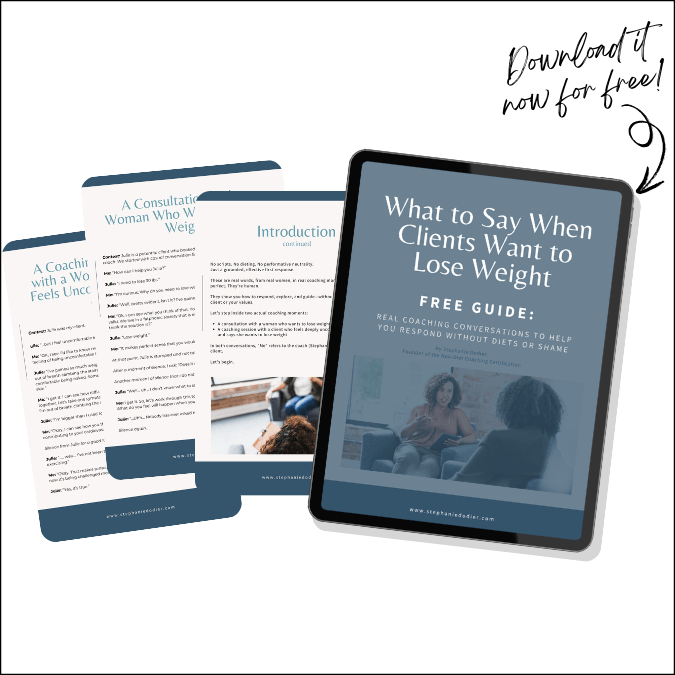
What To Say When Clients Want To Lose Weight Guide
Weight-Neutral Coaching Training
Study Mentioned in the podcast:
Hayashi et al. (2023) — What Is Food Noise? A Conceptual Model of Food Cue Reactivity
Ragen Chastain: What is food noise?
Full Episode Transcript
This transcript was auto-generated and lightly edited for clarity.
Click to expand the full transcript
What is food noise and is it the same as diet mentality?
Yes. Food noise is diet mentality rebranded. It’s the constant mental chatter about what to eat, how much, and what’s forbidden — a signal the body sends in response to food restriction.
Intuitive eating practitioners have coached this for decades under different names: diet mentality, the food police, food obsession. The experience is identical. Only the terminology changed with the rise of GLP-1 medications.
[00:00:03] Welcome to It’s Beyond The Food Podcast, my sisters. I’m your host Stephanie Dosier, and welcome back to another edition of Coach Corner. Now, before I get into Coach Corner, I just wanna update many of you who are seeing a different background. So if you’re watching on YouTube, you’re probably noticing that this is not my regular office.
[00:00:23] I’m actually coming to you live from Los Cabos, Mexico. Today, it’s March the 10th. I’ve been here since January the 22nd. And by the way, I’m living close to a fire station, so you may be hearing some sirens in the back. It’s because the bomberos, I don’t speak full Spanish, it’s just my limited knowledge of his bomberos are living the station right now to go and rescue some people that have some emergency situation.
[00:00:56] So anyway, I’m coming to you live on Los Cabos. As some of you may not know, I’m a digital nomad, which means I have built a way of earning money my business, and to be able to do it from anywhere in the world. That’s what we call digital nomad. So we are nomad the world with our digital way of earning money.
[00:01:15] And right now I’m in Mexico, Los Cabos. And if any of you are interested or if you are digital nomad, I would highly recommend you look into the company with whom I travel, which is called Out Site. And I’m gonna put a link in the show note. I have a, an affiliate link. I don’t do affiliate sale perse, but if you are interested in becoming a member the link will be in the show note and you have property around the world. And we live in community with other single people that are traveling around the world. It’s a pretty cool concept. And I do what we call slow nomad, which means I travel very slowly for a long period of time, and I’ve decided to spend two months here.
[00:01:58] I’m going back home on March the 24th. Year 2026. So yeah, so that’s what I’ve been up to and we just relaunch the next season of It’s Beyond the Food Podcast that will celebrate our 10th year anniversary of the podcast. And I wanted to absolutely bring back this concept that we launch in the last season called Coach Corner, where we take one of your question and I answer it.
[00:02:29] In the last season we did some very short, or I don’t wanna say simple because that wouldn’t be the right word, but very easy to answer question. And so we were able to fit two question in one podcast episode.
[00:02:43] This time I’m gonna take more complex question that require more of an in-depth answer. And we’re gonna tackle the one you guys voted on, which is this whole idea with the concept of food noises and how we can stop food noises without GLP one. Sent an email to the community. If you’re in my community, know exactly what I’m saying.
[00:03:06] Many of you answered that email, so this is the podcast coming from that email. So before we dive in. If you want more Coach Corner episode like this one, I have a free resource for all of you called the Coach Corner Vault. It’s your go-to resource library for practical skill-based coaching teaching and it’s available for you in the show note.
[00:03:35] It’s called Coach Corner Vault. You’re gonna click it, you’re gonna give me your first name and your email. I’m gonna send you this vault of training totally free, very similar to the episode we’re gonna do right now, so it’s available for you. Ready? Let’s dive in on how to stop food noises without relying on GLP one medication.
[00:03:57] So the first part we’re gonna dive into what is a food noise both from an evidence base and also clinical observation. So food noises, although it is something we are recently hearing more and more of is not new and it is not a clinical disease. There is no code for this “disease of food noises.”
[00:04:26] It’s not a pathology at this point in time as of March the 10, 2026. But it’s something that is being talked about a lot more with the rise of GLP one medication. The concept of food noises has is something that has been observed for as long as we have created a solution for eating disorder, particularly I’m referring to the intuitive eating process that was created by Evelyn Tribole and Elise Resch. Where “food noise” was present, but it wasn’t called a food noise. In the intuitive eating framework, it was called Diet Mentality. It was called the food police.
[00:05:14] It was called Food obsession. And it was clearly described as the mental chatter that happened when we are restricting food, the constant preoccupation with what to eat, when to eat how to eat, where to eat, how much, what’s allowed, what’s forbidden. Like the constant mental loop in our head. It’s always been there.
[00:05:43] It wasn’t call food noise. And in the world of intuitive eating certified counselor, that is something that we’ve always coached. And it was so prevalent in the framework of intuitive eating and the research in the study that were made on intuitive eating, that it was one of the first few principle of intuitive eating to be addressed with client naming this diet mentality, food noises, and providing solution to people to reduce the food noise.
[00:06:20] Now with the rise of GLP one food noise has emerged as something that they want to position as different than before. What’s interesting when you think about positioning it as something new that we need a medication for is that this very little research around the concept of food noise.
[00:06:46] The only paper that we have around food noises is linked in the show note. And I’m gonna quote you a direct segment of that research as to how they’re defining food noise. For the sake of definition, food noise could be described as a heightened and or persistent manifestation of food cue reactivity, often leading to food related, intrusive thought or maladaptive eating behavior.
[00:07:17] So as a certified intuitive eating counselor, that’s disordered eating, and that’s the diet mentality that is observed with food restriction and disordered eating like nothing new here. Now the way we think about a food noises in the world of disordered eating and practitioner who use the intuitive eating framework to help client regulate their eating habit is a signal, it’s a warning signal.
[00:07:48] It’s something to be investigated. It’s something to be aware of. It’s not something to be suppressed. And unfortunately, that’s exactly what that GLP medication does, and that’s why patients who are taking GLP one are so vastly positively surprised to find that you can live without all that food noise, that mental chatter in their mind, because that’s partly what GLP one does, is tuning out that signal that the body is sending because the people are hungry, starving, restricting food, because that’s what the diet mentality or the food polices, it’s a signal from the body, call it a nine one one cue to say, oh my God, we are physically hungry. Oh my God, we can’t have the food in front of us. Oh my God, we’re bad for wanting the food in front of us. That’s what this whole food noises does, and GLP one suppress that.
[00:09:00] Now I wanna read you another part of that research because I think it’s very interesting. The first description was from a researcher that attempted to describe food noises because remember, there’s very little evidence-based research on this. There’s not even a clinical definition of it beyond that one description.
[00:09:20] But they also quoted one of the most frequent description from patient on GLP one describing food noise. I’m gonna read it to you. The thing about the bracket weight loss drug, the GLP one, is that they really help me is turning off the signal in my brain that said I need food. It made my tummy feel full and it told my brain, you don’t need it AKA, the food.
[00:09:50] It was like magic. I really don’t know how it works, but it’s magic. That’s what GLP one do. They turn off the alarm signal both physically and mentally that the individual is hungry. Therefore, they don’t feel the need, the urge to eat, therefore, they lose weight.
[00:10:13] Now I’ll project myself and explaining why most people regain the weight posts ending medication of GLP one is because the food noise come back and, and I was reading an article a few months ago around Oprah describing exactly that. I think it’s when she launched her book describing exactly that, that the moment she stopped her GLP one medication within a day or two, the food noise was back.
[00:10:40] Yeah, the food noise was back to tell you you need to eat. So that’s the description of F noise, that’s the state of research around food noise. Right now I wanna give you another perspective before I get into the how to stop food noise.
[00:11:00] What’s interesting when you read the paper that’s in the show note is the gap in the tool to research food noise. One of the primary gap is the inability to measure food noise as we stand today. Science has no tool designed to measure food noises.
[00:11:24] So in order to even attempt a process, a scientific process to measure for noise, they have to go back into what is available right now. And interestingly enough, the researcher have landed in eating disordered assessment tool or disordered eating assessment tool as the first step in an attempt to measure food noise.
[00:11:52] What an analogy, eh. Using eating disorder and disordered eating assessment tool to measure food noises. Should that not lead us in a way of thinking that perhaps just perhaps. There’s a danger in turning off that signal, but that’s an idea for another day.
[00:12:13] So at the end of the day, we are not behind science. We’re not lacking evidence. You’re not lacking knowledge around evidence around food noises. Or more fundamentally, we need to start asking a completely different question. As practitioner, what is the signal? What is the signal telling us? What is it pointing us towards?
[00:12:43] Because as I mentioned earlier, that’s what food noise is. It’s a signal. It’s not a malfunction. It’s not something that is broken. It’s a signal. And our role as practitioner is to help our client listen to the noise with curiosity, with compassion, and that takes skills and framework.
[00:13:06] And that’s what I’m about to share with you, the three step of the three buckets that I look into with a client when it comes to food noises.
[00:13:17] One of the essential element to understanding when it comes to food noise is understanding the root cause of it. And I think I’ve been pretty clear up to now, food noises is a signal that your body is wanting more food, needing more food. Seeing food as a danger, seeing food as something you cannot have and human wants what’s in front of them.
[00:13:43] So the root cause of food noises is restriction. And again, what’s interesting to understand is it’s not new and we have a lot of evidence pointing to the connection between restriction and food noises. The Minnesota starvation study is probably one of the most important body of observation on human hunger, and it demonstrated the connection between the two very clearly.
[00:14:13] The Minnesota starvation studies, when healthy men were placed on a severe caloric restriction and they became obsessed with food it was noted that they dreamed about it. They talked about it consistently. They even went as far as cutting out recipes from cookbook the red and overread menus in the food obsession.
[00:14:36] It was not because something was wrong with them. It was clearly noted through observation that it was due to the restriction and as soon as the restriction was lifted, the food obsessive thinking just went down naturally.
[00:14:50] So when you are with a client and you are with someone who wants to reduce food noises without using GLP one, there’s three area that you need to be focused on. Number one, the cognitive level. Number two, the somatic level, and number three body image. So let me unpack each one of them for you.
[00:15:11] The cognitive level. The first level of food noises is cognition. It leads in the thought pattern, the belief, the rules that people have about food. And most of our clients who experience significant “food noises” are operating under a rigid set of food rules. Rules that tell them which food is safe to eat, which food is dangerous, how much they should eat, how much is too much to eat?
[00:15:38] And it’s all happened in their mind. It’s not their bodily, their somatic informing them. It’s just the thoughts that they’ve been taught by diet culture, by wellness culture around food, and it’s a constant spinning of these thoughts in their head. Their rules are not true. They’re just thoughts that they have learned to think based on their prior exposure to various attempt to control the body or control their health.
[00:16:07] So what do we do with that? This is where the cognitive behavior coaching framework comes in and play a vital role in helping identifying the thoughts. So one of the tool that I can refer you to, and I’ve talked about this many times on this podcast, is the thought download where either yourself, if you are the one who’s having some food noises.
[00:16:32] We take a piece of paper and we put the circumstance at the top of the paper for an example. I don’t know. Food rules, and then we write all the thoughts that we know we have regarding food rules, and we make a full download from our mind to our piece of paper, and we look at all the thoughts we’re having and.
[00:16:55] You can ask yourself a few question, right? When you look at these, this thought download of all the food rules, you can ask yourself, is this food rule a fact or just something that I’ve picked up along the way. So remember that the difference between a thought and a fact circumstance is, can I take this piece of information in front of a court of law and be educated that it is a fact?
[00:17:23] Or can I take this food rule and observe that everyone in the world obey to the same rule? That’s a fact. Example of a fact. I need to drink water. That’s a fact that all human being need to drink water. We need to avoid gluten, right? Gluten is bad for you. Is that a fact or a thought? Now, is it true that gluten is bad for all human being in the world?
[00:17:55] The answer is no. It’s very highly individuals based on your biology, based on your life experience, based on other health factor. So that’s a thought. The thought that you have around gluten, is it based in fact in which you’ve been diagnosed with the celiac disease, or it’s just an observation of thought that you have heard.
[00:18:15] So go through your thought, download, help your client make a thought download. And Identify which one are thoughts, which one are fact. Once you’ve made the bucket of thoughts, where did I learn this thought? Where does it come from for each and every single rule? Where did it come from? What is this rule costing you?
[00:18:36] Is it true that it’s impacting you? Is it just something that you do from a performance base and I’ll have a upcoming episode on performative eating. ’cause many of our food rules are performative eating behavior. So we can get recognition so we can get people to hold us in higher esteem because we’re eating in a certain way.
[00:18:58] Where does this rule come from? What is it costing is something that I do for performance or something that I really need from a wellbeing perspective. Challenge every single rule and help your client do this.
[00:19:14] Now what will happen as you do this is we realize that most of the thought running in your mind or your client mind are not true fact. They’re just thoughts that we’ve collected, rules that we’ve collected that are really no demonstrating factor within us. Once we start eliminating, because that’s the next step, right?
[00:19:36] Eliminating all those food rules that are actually not. Rules of law, but only thought that we have. We are left with a much more open choices of food and eating habit in front of us, which in one way I can say it’s the one-liner of intuitive eating process. It’s about opening up our freedom around food and making food-based choices for our wellbeing and our satisfaction instead of rules we’ve collected over the years.
[00:20:09] Once we start removing the restriction, the chatters goes down because the nervous system is not activated with all the rules it needs to follow and all the danger in front of it and the mental chatter reduce, and we can use other tools within the cognitive behavior framework to help reduce even further the thinking process we have to do before eating choices.
[00:20:36] And then we can build a collection of guidance around food. Notice as I say, rule, but guidance based on the individual, which, if you’re familiar with the I Eating process, that’s the end part of the process, which is gentle nutrition. Gentle nutrition is when the individual has done the work to observing their food rules has reconnected with hunger and fullness and satisfaction, which I’ll talk about in a minute, and then is ready to re-explore nutrition for their individual body, their individual life experience, and then collecting a bunch of guidance on how. Each food is reacting with their body and making them feel good or not so good.
[00:21:27] Creating their own guidance, not rules, because as soon as we set up a rules, we go back into the restriction, into the food noises, but guidance around food so that they can feel good.
[00:21:43] The second level we need to explore with our clients is the somatic level, the physical level, the body base reason as to why food knows what happened.
[00:21:55] The researcher pointed that the eating cue reactivity and there’s one particular cue eating cue want to focus on today because one that we’re not familiar with, if you are not trained in intuitive eating. You perhaps don’t even know about this eating cue, which is the satisfaction cue. So everyone is familiar with hunger and fullness.
[00:22:18] Eat when we’re hungry. If you wanna reduce food, noise, eat when you’re hungry. ’cause every time you’re physically hungry. Your body will send signal through your nervous system into your brain to think about food and to some degree to make you obsess about food so that you eat. So if as soon as you feel hungry, you eat, you eliminate the whole drama in your mind of needing to eat right. Hunger cue.
[00:22:46] The second one is fullness cue. Now, I’m not gonna expand on that today, but enough to say that it’s not about stopping eating when we’re full. The fullness cue is on the spectrum. It’s about asking yourself, oh, okay, I’m starting to feel full right now. Is that enough for me? It’s about asking the question always with the permission to continue to eat if that’s what you want.
[00:23:13] Now, the cue that many are not aware of is the satisfaction cue. It’s not only eating when you’re hungry, stopping eating when you’re starting to feel full, but it’s also eating food that makes you feel satisfied, and that’s a somatic cue. And most food that makes human being feel satisfied have been ruled out by diet culture, wellness culture.
[00:23:39] Think about sweetness. Sweetness is one of those satisfaction cue that nearly all human being enjoy. People enjoy sweet food for many reasons. There’s a lot of literature around that, but we love sweetness and that is a way that we feel satisfied with food. The more food tastes there is in the meal, the more satisfied we’re gonna be.
[00:24:08] So if there’s a little bit of sweetness in your meal, you will feel more satisfied. So when you cut off. The sweetness flavor of your food, for sure. Your body will crave it, especially when it’s in front of you. You will obsess about it. You will obsess, obsess, and at some point it will be so obsessive in your mind that you will break the rule and you will start quote, eating, overeating, and binge eating the sugar.
[00:24:34] The solution is to allow for sweetness to be present in your day-to-day life and eating interaction, so looking for satisfaction in. The various food choice you’re eating, and this is how we guide our client, exploring all the flavor and the taste.
[00:24:53] Exploring cultural food, exploring family-based, traditional food, exploring recipe that your mom used to make when you were young or specialty food that reconnect you with strong emotional memory and bringing back these food into your day-to-day food interaction so that you can feel satisfied. When someone is satisfied with their food choices, they feel full and good. The food noises go down.
[00:25:26] Now the third area we need to look at is the untethering of food from body size. As long as a person has a belief system that what they eat, how they eat, how much they eat creates their body size and that their current body size is not what they want it to be. Therefore, the individual is not accepting of their body.
[00:25:57] They will forever have rules restriction restraint around food, which will start the loop again of food noises we need to untether our eating habits, our heating behavior, our nutritional choices from a control of our body size, and that comes through the medium of doing body acceptance, body image work.
[00:26:25] So I want you to think of body acceptance in the context of food noises as not something “add on”, but it’s a clinical prerequisite to reduce, eliminate stop food noises. And I have no statistic, no evidence on this. This is clinical observation in my now 11 years of working with people at a nutrition level.
[00:26:52] I have never encountered someone who had a peaceful relationship to food while hating their body or having a poor body image. The two have always been intertwined. So if you’re working with anyone at the nutrition, the eating behavior level, bringing the work of body image is required. It’s not something as an add-on or on the side.
[00:27:23] It’s work that must be done with your client and to stop food noises, that work must be done. So here’s what I want you to take away for today. Food noises is diet mentality. Food Police rebranded under a new name. It’s a signal from the body that needs to be listened to and investigation must be done.
[00:27:51] GLP one Medications suppress that signal. Coaching resolves the cause. As a non-diet practitioner, there’s a three level framework that must be in place for you to address food noises. Cognitive level, somatic level, and the body image untethering from food choices and eating behavior.
[00:28:18] Is it true that some people may need GLP one to reduce the noise? Probably there’s a very small percentage that may have some mental health diagnoses, mental health issue that may require temporary permanent GLP one to address the food noises, but that’s a zero. I don’t have a statistic, but I’m tending to say less than 1% of a clientele base. Most people, if you work at the three level framework, I gave you the food noises, if not completely stop, will with time significantly reduce where it no longer be an issue.
[00:28:58] And that’s the work. It’s the work that you can do. It’s the work that anyone can do with the right framework. If today’s episode made you realize that’s the kind of coaching you need for yourself or that you want to do, that’s what we do In my world. We go beyond the food to address food noises at the root causes in this case.
[00:29:24] And we have two places where you can come and work with us, the groundwork, which is the baseline work that we need to do with the beyond the food method. And then there’s a non diet coaching certification where we take your skillset to the next level professionally to work with people. Both program are linked in the show notes, or you can find out more on our website at www.stephaniedodier.com.
[00:29:51] Thank you for being here, my sister, and I’ll see you on the next podcasts.
[00:29:56] If this resonates with you, the next step is the groundwork, my Beyond the Food Foundational Program for Health Professional, ready to go beyond the food and rethink how they approach nutrition eating and health behavior starting with themselves. You can go to www.stephaniedodier.com/groundwork and join us now.