

In this episode, I’m kicking off a two-part series on something I’ve wanted to teach for a long time. Part one is the psychology of eating. Together with part two — the physiology of eating — these episodes are the foundation of how I think about eating behavior. And eating behavior is what determines your nutritional outcome. Not the food rules. Not the meal plan.
Whether you’re a health professional working with clients or a woman navigating your own relationship to food, this is for you. I break down the belief-to-behavior chain, expose why diet culture needs you to stay disconnected from your own psychology, and share two real client stories that show what changes when you finally address the why behind eating.
Episode Highlights & Timeline
[00:00] Why I’m doing a two-part series on the psychology and physiology of eating.
[04:48] Why nutrition is the outcome of eating — not the other way around.
[10:00] The belief-to-behavior chain that drives every food choice you make.
[16:11] What “comfort food” actually means psychologically — and what restricting it really costs you.
[21:06] A real client case: how childhood food scarcity created compulsive eating at 35.
[25:07] Why diet culture structurally depends on keeping you disconnected from your psychology.
[32:22] What you can do right now — as a professional or on your personal journey.
Mentioned in the show:
Non-Diet Client Assessment Tool
Non-Diet Coaching Certification Waitlist
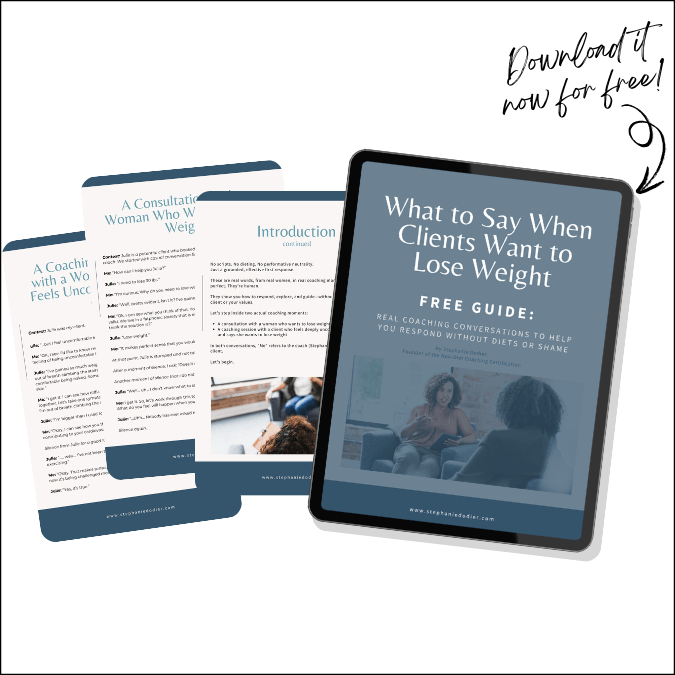
What To Say When Clients Want To Lose Weight Guide
Weight-Neutral Coaching Training
Full Episode Transcript
This transcript was auto-generated and lightly edited for clarity.
Click to expand the full transcript
What is the psychology of eating and why does it matter?
The psychology of eating is the complex interplay between your belief system, thoughts, emotions, and eating behavior that determines your nutritional outcomes. Nutrition is not something you do — it is the result of how you eat. And how you eat is driven by why you eat.It matters because no food rule or meal plan addresses the root. Beliefs shaped by culture, family, trauma, and social conditioning drive eating behavior — and until those are addressed, nutritional outcomes don’t change.
Episode Transcript
[00:00:03] Welcome to Is Beyond the Food Podcast, my sisters. I’m your host Stephanie Dodier, and today we’re gonna talk about something really cool that I came up with. The fetish of consistency and why the obsession that we have in our culture to chase consistency is actually what keeps us stuck as women, particularly in our area of concern here, which is health behavior, and instead of chasing consistency, fetish. Perhaps we should have a fetish for flexibility. I’m just saying.
[00:00:03] Stephanie: Welcome to It’s Beyond the Food My Sisters. I’m your host Stephanie Dodier, and today we are starting a two part series and we are going to talk about something I’ve been wanting to teach for a long time, and because it’s long, I’m bringing it to you in two parts. This episode is part one and it’s the Psychology of Nutrition.
[00:00:25] And the next episode we’ll focus on the physiology of nutrition. Together. These two episodes are how I think fundamentally about eating behavior, and eating behavior is what determines your nutritional outcome, not the food rules, not the meal plan. The behavior and the behavior. Start with understanding the why.
[00:00:53] Whatever you are, health professional working with clients or woman navigating your own relationship to nutrition, this is for you. Both paths matter here and I will speak to both. Ready? Let’s do this. Now first I wanna talk to you about my life update, because if you’re watching this on YouTube, you probably notice a different background.
[00:01:16] And it’s because I’m home now. Today is March 31st and I arrived back home not even two days ago from a two month, almost eight, nine weeks in Mexico because I’m a digital nomad. Longer story, not for today’s podcast, but I redesigned my life at the age of 40, left my corporate career behind and went back to school, got my nutrition degree, and became a nutritionist, and built a business to give me freedom.
[00:01:56] And that freedom for me was traveling. So I’m living my desired life. I built a lifestyle business that allows me to live the life that I wanted. So that’s — I should do a whole episode on that. I haven’t talked about that in a long time in depth. Maybe there’ll be not the next episode, but the one after.
[00:02:17] But anyway, I came back from a two month trip in Mexico. I’m back home for potentially another six to eight weeks, and then I’m gonna be going to another destination. And this is why the background is different. So for those who are listening in audio, you’re probably noticing some yellow and green tones in my background.
[00:02:38] That’s my office, and I gotta make sure that matches the green theme of my office. Again, I won’t expand on that because a minimal amount of people are watching on YouTube, but if you are, you’re probably noticing that. So I’m back home. I had a number of flight delays. I left on Friday at 10:00 AM and I arrived home on Sunday afternoon, which was supposed to take eight hours, and turned into a three day trip.
[00:03:07] But all along the way, I kept coaching myself using the self-coaching framework, which by the way, I’ll be teaching in the Groundwork coaching experience, which will be starting mid-April. I’ll talk about that later in the podcast. But I was coaching myself throughout all the flight cancellations and delays.
[00:03:33] And the terrible hotel that the airline provided. Through the fact that I’m living my desired life and one of the coaching principles I teach is 50/50, right? Life isn’t supposed to be perfect and this idealistic point of view. Life is supposed to be 50% great, amazing, perfect, idealistic, living your goal, and the other 50% is supposed to be not so fun.
[00:04:05] Difficult, challenging, whatever name you wanna give it. It’s supposed to be that. And for those three days I was living that 50% and I kept coaching myself that this is just the 50% of life that is not supposed to be fun. And I’m in it right now and it’s only temporary. And because of that, I was able to enjoy the process, sleep eight hours a night and somehow be content. So all the little coaching principles that I use in my practice with the people I work with and also that I teach. But that is not the psychology of eating.
[00:04:48] All right. Let’s get into the psychology of eating, or the psychology of nutrition.
[00:04:55] This topic came out of building the curriculum for the Groundwork, which is a coaching experience that will be launching on April the 14th, and I wanted to design a program that is different from the Non-Diet Coaching Certification, which is where we teach how to coach other human beings. I wanted to build a program so that women could do their personal work and if they desire, in the future become a professional.
[00:05:30] And I used to have a program similar to that, in 2019 and 2020 pre-pandemic, that was called the mentorship. And I wanted the Groundwork to emulate an environment where I can mentor women in the Beyond the Food Method. So it needed to be something very applicable, something tangible and applicable where women were moving forward using a very narrow context and specific application.
[00:06:00] And I chose eating and nutrition because this is the number one layer of the Going Beyond the Food Method where 90% of women notice or experience what they call a problem, a challenge, something that they want to change.
[00:06:31] And for all the reasons in the world, that’s the most approachable layer. The next layer would be body image. But that is what I call the model behind the model, right? The driving force behind the nutritional eating behavior model, which is most common out in the world, is people want to change their eating behavior.
[00:06:57] And for our industry, people know that in order to change their eating behavior, they need to change what is commonly referred to as the relationship to food.
[00:07:10] So I wanted to create an experience where we can practice the different elements of the Going Beyond the Food Method on yourself, not just as an intellectual framework, but something that is applicable. So in order to do that, I decided to start with eating behavior.
[00:07:30] So in our world, we talk a lot about intuitive eating. When I say our world, I talk about our specialty, which is a non-diet approach to health, or otherwise known as a weight neutral approach to health. One of the most familiar frameworks is the intuitive eating framework.
[00:07:53] And if you studied intuitive eating or read the book, you know that the first few principles are about the psychology of eating. This is where we talk about the food police. This is where we talk about diet mentality. But the framework of intuitive eating is not designed as a psychological approach. It is an approach created by two dietitians, which is an eating behavior based, nutrition based approach.
[00:08:25] So it has a limited amount of tools when it comes to the psychology of eating. And what I have found over the last six years now of working with professionals is that they found themselves often feeling out of scope when they consider working with the psychology of eating. So I wanted to be direct about this.
[00:08:51] And I wanted to create in the Groundwork a framework where I can teach you these tools, at least the first layer of tools, to help with the psychology of eating, both in your own relationship to food and for the people you may work with in the future.
[00:09:09] Let’s start with a frame that I want you to hold throughout this two-part series, which is this one: nutrition is the outcome of eating, not the other way around. Nutrition is not something you do. It’s not something we can actually have as a three-dimensional behavior. In the real world, how we pursue nutrition is through eating.
[00:09:38] Eating is a behavior. It’s how the nutrition comes to life. So nutrition is the result of how we eat over a period of time.
[00:09:53] And eating is a behavior, it is a choice, a reaction — if you think about a behavioral model. So when we think about the science of the behavior of a human being, there’s a model of how human behaviors are created. It starts at the very top with a belief system, right? A view on the world that we have.
[00:10:22] And from that view of the world, we then generate cognitive thoughts. That’s the cognition, right? We create thoughts based on our various belief systems we hold in our brain, and these thoughts ignite in our nervous system a bunch of sensations that are commonly known as emotions. And these emotions then have a reaction.
[00:10:51] That brings a behavior to life in the world. The way that humans interact with the external world is through our behavior. It’s how we externalize our cognition and our nervous system. We externalize into the world through behavior. We externalize nutrition through our eating behavior.
[00:11:15] So when we wanna understand nutrition, we have to understand the eating behavior, and to understand our eating behavior, we have to understand what drives the behavior, right? What drives the thoughts that engage into this behavior?
[00:11:35] There are two components there. There’s the psychology of eating and the physiology of eating. And I like to think of it as why we eat. Very commonly, we hear about what to eat, when to eat, how to eat — that we’re entertained with nonstop by wellness and even diet culture on social media, in articles that we read, in books.
[00:12:04] But very few times are we entertained about why we eat, which is the psychology of eating and the physiology of eating. So if you coach health and/or nutrition, you cannot coach without the psychology and the physiology of eating.
[00:12:22] Now, let me be upfront with you. I’ve been in practice for 10 years right now, working exclusively with women for those last nine out of those 10 years, specifically focused on nutrition because that’s what I studied, and I have not yet met or encountered someone who did not have impact on both parts of why they eat.
[00:12:51] People can grapple with both psychological factors that influence their eating behavior and physiological factors. If you are someone who struggles with nutrition and making choices with food, or you work with those people — it’s not an either/or. It’s both.
[00:13:11] So the definition of the psychology of eating, which is what we’re gonna focus on for the rest of the podcast, is defined as a complex interplay between our belief system, our thoughts, thought patterns, our emotions, and our reaction to those emotions, which is our eating behavior, and the outcome of that — the food choices that we make, which then result in our nutrition.
[00:13:38] Some of you may be familiar with the social determinants of health, which is a number of factors — the social elements that impact our health. Those social determinants of health, we can call them the social determinants of our eating behavior. They’re also all present within our eating behavior.
[00:14:00] This is where we talk about societal norms. We talk about economical status. We talk about cultural background. We talk about race, we talk about gender. We talk about systems of power. We talk about politics, all the social environments that influence the belief system of the person having eating behavior.
[00:14:25] We can also talk about family dynamics. We can also talk about trauma. One that is very commonly present with people that have eating behavior disturbances is diet trauma, right? The traumatic experience of moving through periods of restrictive eating with the pursuit of a smaller body. That’s a traumatic experience.
[00:14:57] We know scientifically that it’s traumatic to the physiology of the body through something called weight cycling, and it’s been research-established that weight cycling — periods of losing and gaining weight — creates, just one of the symptoms or the side effects of weight cycling, is inflammation, blood pressure, cholesterol. These are the things that we know physiologically. Mentally, there are also traces that are left from those periods of restriction in the trauma — the mental and emotional trauma associated with dieting.
[00:15:33] So the social context, the historical context, that influences the belief system, that shapes the belief system, the thoughts that people think about food, about the consequence of eating food, that shapes the emotions, the relationship that people have, their emotional relationship to eating, and that directly creates impact on eating behavior, the choices that people make with food.
[00:16:11] So I wanna give some very specific examples of the psychology of eating, and I’m gonna use first the term comfort food. When I say comfort food, food that for a multitude of reasons brings comfort or brings safety to a person, and that when we think about them, when we eat them, it brings up a feeling of comfort, of safety, a memory that is associated with that food that makes you feel that level of safety, of comfort. It could be a cultural food, it could be a racially identifying food that is at work.
[00:16:42] So for an example, for me, I am a French person, so my lineage is from France. My lineage is European. My lineage is white European descent.
[00:17:08] So for me, my lineage has been accustomed to recipes with bread, with potato in almost every single meal that we ate because that was the food that was around us. And from my great-grandmother to my grandmother, to my mom, all the recipes I was raised with were around bread and potato. So I have a huge feeling of safety and comfort when I eat bread.
[00:17:42] So imagine the result of me going keto. One of my latest diets 12 years ago was the keto diet, and so I had to cut out of my diet potato and bread. So not only did I remove the physical potato and bread out of my diet, but I also removed many experiences of comfort and security out of my life by removing these foods.
[00:18:13] And psychologically, my brain had one less anchor of safety and comfort by removing the food. So I was exposed. I was triggering my nervous system because I was bringing less safety and comfort by removing these foods out of my diet. Not only that, but it also caused even further small trauma, by an example.
[00:18:43] I remember vividly going to family gatherings and seeing all these foods on the table and not being able to enjoy the food that my aunts, that my grandma had made, because I was on a diet, or I was not eating carbs. In my wellness culture days I was admonishing people who were eating carbs, myself included, because they were quote “bad for your health.”
[00:19:13] So I was lacking comfort, safety. I was preventing myself from the joy of sharing food with my family. I was also not creating bonding with my family because I wasn’t eating these foods.
[00:19:28] Now you could contrast that with people of Asian descent for whom rice holds that same depth of meaning. For me, rice was never really a thing because it wasn’t part of many events in my childhood. We didn’t eat rice at home. But for people of Asian descent who are being told that rice is bad for your health — and I can just picture right now, it’s not even just Asian descent, it’s Latin descent.
[00:19:59] I have a friend called the Latina Nutritionist who is from Latin descent. And for her, she grew up with rice and she constantly on social media shared the traumatic impact of her days in wellness culture being told that white rice was a bad food.
[00:20:19] And that restriction, because of the bondage, the comfort, the safety, the memory, creates for most people episodes of binge eating — where you have such good comfort memory associated with it, and perhaps you are in a moment of your life where you feel really unsafe because something’s happening in your life.
[00:20:43] You need safety and you can’t rely on the food because they’re “bad food.” You’re restricting them. And then you accumulate that lack of safety and comfort in your body, and you accumulate, you accumulate, and at some point it’s just too much. You reach out for the food and that’s when the rebellious eating behavior engages. The binge eating behavior will engage, right.
[00:21:06] Here’s another example. This is something I was working on with a dietitian who had been through a traditional approach of teaching dietetics, which was all about weight-centric — where food was positioned as this tool to achieve health by restricting the food so that people can lose weight.
[00:21:30] And she had encountered my podcast. She had encountered the term weight neutral approach to health. And that culture was like, oh my God, this is so exciting. And she started reading the book and doing the work on her own and she wasn’t quote unquote ever getting there, right? So she came into one of my programs.
[00:21:52] We started to work together, and we started to unpack her rebellious eating pattern, which was not necessarily binge eating for her, but was just uncontrollable compulsive eating that she couldn’t explain why. And we started to use cognitive behavior coaching and Socratic questioning. We started digging into the psychological elements of a relationship to food, and then we discovered how her mom maintained the food environment at home.
[00:22:25] Her mom was a single mom that was living paycheck to paycheck. She was raising two kids paycheck to paycheck, and one of the ways her mom did to control how much the two teenage kids were eating was by putting a lock on the fridge, on the freezer, and on the cupboard — because teenagers are teenagers, they eat a lot.
[00:22:50] Her paycheck could not afford it, so she started locking the food in the house. And that left traces on my client, who is now 35 years old, who every time there’s no food available, for what she said were unknown reasons, compulsively felt the need to eat. It was the traumatic experience of not having the food available because of economical status.
[00:23:21] Her mom’s economical status made the food unavailable and she was replaying, at 35, that same model. But because she wasn’t able to put her finger on it, she wasn’t able to name it because she didn’t have the tools to go to that psychological layer of her eating behavior. She kept repeating the pattern.
[00:23:43] Today at 35, even though she had all the science background of nutrition, she had her five-year degree, she was studying intuitive eating — yet she couldn’t put her finger on it. And as soon as we were able to put the finger on it and bring an explanation as to why she had those compulsive eating behaviors, the pattern started to melt.
[00:24:08] It didn’t disappear. But it started to melt. And then we were able to put a very specific plan to titrate her nervous system in order for her to bring back safety — that she was never going to be out of food again, and that food would be constantly available in her today’s world. So she stopped playing from the brain of herself between the age of 15 and 19 when she left home, of how food was managed, and she started to act with the 35-year-old brain and psychology.
[00:24:50] So she was able to start shifting her practice by integrating intuitive eating, the psychology of eating, and cognitive behavior coaching in her practice, and helping other people from that lens.
[00:25:07] So why is this so rarely addressed? Why are most nutrition conversations still happening at the level of what you eat, when you eat, how you eat, rather than the why behind the eating behavior? Because of diet culture and wellness culture, which requires us to stay disconnected from the psychological factors influencing our eating behavior.
[00:25:39] And here’s the logic for this. When we actually understand the psychological factors that influence our eating behavior, when we understand how powerful they are in shaping our nutrition through our eating behavior, we have no choice but to address them. We have no choice but to respond to them. And then when we do that, it gets in direct conflict with the normative, restrictive eating direction of diet culture and wellness culture.
[00:26:10] You cannot maintain a restrained, restrictive control approach to nutrition if you are also fully honoring the psychological roots of your relationship to food. They’re incompatible. Human beings need agency and autonomy in their relationship to food. But that’s the counter notion to diet culture and wellness culture, which require restraint and restriction, especially in an environment of abundance of food.
[00:26:47] So in order for diet culture and wellness culture to keep selling control over your body, over your weight, over your health, you, as the recipient of that culture, have to be disconnected from the psychology of your eating. That’s not accidental. It’s structural. The system depends on you not knowing your own why you eat and not acting upon your why you eat.
[00:27:20] And this affects everyone. When I say everyone, I mean all the identities, all the genders, and all of the bodies. But it falls harder on women. And the reason for that is that women are socialized to the thin ideal, right? From childhood, through media, through culture, through family, through friends, we are socialized to believe that being small as women, taking up less space verbally, psychologically, physically, being aesthetically pleasing to the male gaze, is what makes us as women good enough.
[00:27:54] That socialization — this is how we are programmed. And the vehicle through which women are expected to achieve that thinness is food. Restricting food. Lose weight through restricting food and then you will be worthy.
[00:28:28] So you’re damn sure food becomes loaded with the moral and physical weight. What you eat becomes a statement of who you are — or should I rather say, what you don’t eat. This is so relevant in terms of wellness culture, and I keep saying I’m gonna do an episode on performative eating and I promise it’s coming, because your ability to perform your worth into the world through the way you eat is real.
[00:29:01] And so, because food choices, because nutrition holds so much weight — the psychology of eating cannot be honored. It must be overridden. Because if you actually honor the comfort, the safety, the culture, the history, the healing, the trauma, you cannot maintain the restriction. So the cost is enormous on women. It’s enormous on mental and emotional wellbeing.
[00:29:33] A normal, uncomplicated relationship to eating is the healing outcome.
[00:29:43] That’s why I keep saying intuitive eating is a process to get back to a state of normal eating where you can engage with food from a place of comfort, from a place of safety, from a place of honoring your identity, your race, your culture, where you come from — create joy, create safety, create happiness through the way you eat.
[00:30:09] Because that’s part of the eating experience. That’s part of the nutritional outcome. Again, when we think of nutrition only from a physical standpoint, we only see macro and micronutrients adding up to some kind of bodily function, but we completely erase the psychological, emotional wellbeing, and even spiritual wellbeing — when you think in terms of religion or spirituality and food that honors that religious or spiritual activity being in your diet, being available when you go through the rites of your spirituality or religious activity.
[00:30:55] Because I’ll just say this — I’m from a Catholic background, although I don’t practice anymore. I remember vividly having a client who was a practicing Christian who had a real struggle going for the rite, which is a little piece of bread in the Christian rite where you have to eat that.
[00:31:20] But she was gluten-free. It was part of unpacking her psychology of eating, and she had a real need for spiritual fueling that she could not honor because she was quote unquote gluten-free for absolutely no medical reasons — she was not Celiac. It was just one of the leftovers of wellness culture in her that we had to work through, that allowed her to go back to the rite of her chosen religion.
[00:31:47] Now another caveat I wanna make here, in case you’re new — there is a difference between health and wellbeing, right? And I keep talking to wellbeing because wellbeing is where we take into account that we are more than a physical being. We think about wellbeing from a place of mental, physical, emotional, and spiritual connection, social factors, instead of just a list of blood markers that establish if you are healthy or not.
[00:32:22] So how do we change or impact the psychological factors in our relationship to eating? So if you are here as a professional, the first place we need to start is listening to this episode and understanding that the goal of nutrition is not just maintaining a certain physique. It’s the nourishment of all parts of being a human — mental, emotional, spiritual, and physical.
[00:32:50] That’s the first place. The second place is when you are leading, engaging, coaching, counseling people in nutrition — we need to evaluate people on these psychological factors that influence their relationship to food, their eating behavior. So today I’m talking about the psychological factors, but don’t forget there’s an upcoming episode that will talk about the physiological factors of our eating behavior. But we need to evaluate for the psychological.
[00:33:21] For this element, I have a free tool you can go and download that’s called the Non-Diet Client Assessment Tool. It’s in the show notes. It’s on my website. You can Google “non diet coaching assessment tool,” it’s free. Download it and start — first of all, before I say start using it with your patients or clients, use it on yourself.
[00:33:43] That’s right. Evaluate your own psychological and physiological factors and the impact that they have on your relationship to food or eating behavior. And then if you’re a professional and you are helping people with their nutrition and their health, then start addressing the psychological and physiological factors, not just the nutritional outcome. Because remember, nutritional outcomes are the outcome of our eating behavior.
[00:34:18] So we need to address — we need to go the layer deeper, which is the eating behavior through psychology and physiology.
[00:34:25] If you are combining both professional and personal journey, or you’re just on your personal journey and you’re listening to me, go download the tool too and evaluate, without the help of a professional, your relationship to food. The Non-Diet Coaching Assessment comes with a podcast episode — kind of a mini audio training on how to assess yourself.
[00:34:49] So take the assessment yourself and identify all the questions. There are 20 questions that are part of the assessment. They’re either from the psychological factor pool or they’re from the physiological factor pool. So very quickly, looking at the nature of the question, you’ll be able to identify what most influences your current relationship to food, AKA your eating behavior.
[00:35:16] One podcast episode that may be really helpful for you is Episode 422, where I talk about both the difference between nutrition and restrictive eating — because they are not the same — and then I also talk about reconnecting to hunger and fullness cues. Now, this is in the free bucket of things you can do to work with me.
[00:35:40] If you wanna move faster through this and with a more supportive framework, that’s when you can come and work with me within the Groundwork, which is my coaching experience, where I become your coach to help you unpack your relationship to nutrition, psychology of eating, physiology of eating, health behavior, and also along the way, I’m teaching you the self-coaching framework, which is a method by which you can impact, in this case, your psychology of eating.
[00:36:15] It’s actual tools to change the psychological factors that will impact your eating behavior, therefore your ability to impact nutrition in your life. The Groundwork is all about embodiment, not intellectualization. Because 10 years of experience, I can tell you, people get stuck in intellectualization.
[00:36:40] People want the next book to read and the next podcast to listen to because they think if they understand it more, if they have more science, that’s gonna change their behavior. Which it’s not. We don’t change behavior through new intellectual information. We change behavior through embodiment practice and titration. And that’s what we’re gonna do in the Groundwork together.
[00:37:06] You can find that on my website, stephaniedodier.com/groundwork, or the link in the show notes. I’ll see you in part two, which is the physiology of nutrition, or physiology of eating. Thank you, my sister, for being here. I love you. See you in the next podcast.
[00:37:28] Stephanie: If this resonates with you, the next step is the Groundwork, my Beyond the Food Foundational Program for Health Professionals ready to go beyond the food and rethink how they approach nutrition, eating, and health behavior — starting with themselves. You can go to www.stephaniedodier.com/groundwork and join us now.