

In this Coach Corner episode, I answer a question that sits at the heart of my methodology. Why do I include feminism in the Beyond The Food Method? I walk you through the research first, then show you exactly what it means for your coaching practice.
The answer isn’t political. It’s clinical. And once you understand the gap between holding a feminist belief and actually claiming a feminist identity, you’ll never look at client resistance the same way again.
Episode Highlights & Timeline
[00:00] Why feminism is built into the Beyond The Food Method, and why it makes some practitioners uncomfortable.
[01:43] Breaking down the 2016 Borowski study on feminist identity, body image, and disordered eating in 1,200+ young adult women.
[03:01] The finding that stops most people: the feminist label itself did the protective work, not just holding the belief.
[05:08] Socialization explained: why women privately agree with feminist ideas but won’t claim the label publicly.
[08:12] What this means for practitioners teaching intuitive eating, and why the 10 principles alone aren’t enough.
[13:47] Why feminism is embedded in the Beyond The Food Method, and what real lasting behavior change actually requires.
[16:34] Naming healthism: the gap the 2016 research didn’t capture, and why it’s the next layer of work for most health professionals.
Mentioned in the show:
Study mentioned in the episode
Non-Diet Coaching Certification Waitlist
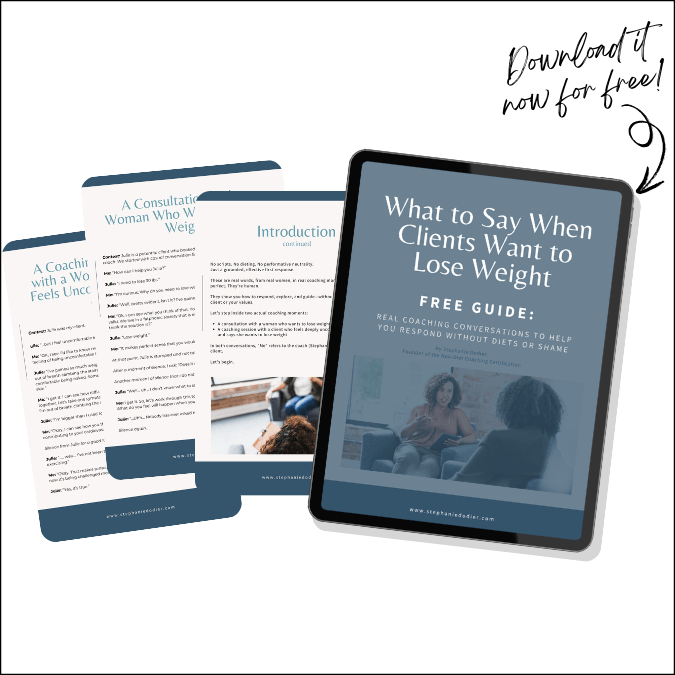
What To Say When Clients Want To Lose Weight Guide
Weight-Neutral Coaching Training
Full Episode Transcript
This transcript was auto-generated and lightly edited for clarity.
Click to expand the full transcript
Does feminist identity protect women from disordered eating?
Yes. Research shows women who self-identify as feminists report significantly higher body satisfaction and lower eating disturbance than non-feminists. Critically, holding feminist beliefs without claiming the label provides no protective effect. The act of embodying the identity — publicly rejecting the societal norms that drive body dissatisfaction — is what creates the change. Belief alone is not enough.
Transcript
[00:00:02] Stephanie: Welcome to It’s Beyond The Food Podcast, my sister. I’m your host, Stephanie Dosier, and today in a Coach Corner episode, we are answering a question that gets the heart of my methodology and why it looks different from most non diet approach you perhaps encountered or seen.
[00:00:20] The question is this, why do I include feminism in my teaching of the beyond the food method? And I wanna answer this question, not just from my own personal lived experience, but also from a research perspective because this is not a political stance. This is an evidence-based clinical rational behind integrating feminism.
[00:00:42] Before we dive in, I wanna make sure that you know about the Coach Corner Vault. Every single Coach Corner episode, every question, every framework, every practical tool lives at stephaniedodider.com/coach-corner, which is a bunch of mini live training and free resources. So if you go to the show note, you will see the link to grab the Free Coach Corner vault.
[00:01:06] So here’s a question that came up in one of my webinars. Stephanie, why do you include feminism in your teaching in the Beyond the food method? And I love this question so much that I created this podcast episode because it asked me to justify some things that some practitioner find very uncomfortable.
[00:01:25] And I think that discomfort is exactly the point of creating this methodology in this podcast and the webinar that I owe. So let me walk you through the research first and then I’ll show you exactly how this changed the way you can coach.
[00:01:43] Let’s start by reviewing the research. In 2016, Borowski and colleague published a study in a Journal of Eating Disorder using data from Project EAT three, which is a large racially diverse community-based sample of 1200 young adult women between the age of 20 and 31. And in the research that set out to examine the relationship between feminist identity and two other things.
[00:02:13] Which is very relevant to us body image and disordered eating. So here is what they found. Women who self-identify as feminists reported significantly higher body satisfaction than non feminist women. And that association held after controlling for race, age, education, and also BMI. But here’s the nuance that most people miss.
[00:02:42] Of the 1,241 women in the study, only 14.5% self-identified as feminists. Another 49% held the feminist belief but did not claim the label, and 36% did not consider themselves feminist at all.
[00:03:01] Now where it gets interesting is the women who held feminist belief but did not identify as feminists, their body satisfaction was no different than the non feminist group. Now we’re gonna pause here for a minute because this is really important. The label itself, a feminist did the work, not just the belief.
[00:03:27] So what does that mean? Believing in something and embodying it are two completely different thing, and that gap has a real consequence for the women we work with.
[00:03:43] So why is there a gap between feminist identity and feminist held belief?
[00:03:53] And there’s one word for that, socialization. So why would holding the belief not be enough? Why does self-identification quote, holding the label matter again, the answer is socialization.
[00:04:10] Women are socialized from the time they were very young to comply to find their self-worth their self-esteem externally to them. through compliance, through Being good girls. through doing the right thing. through having a small body. through being optimally healthy. I mean, you can go. Through the feed of this podcast and find a number of episodes around the Good Girl Syndrome and its impact both on our health, our eating behavior, and body image.
[00:04:47] And most recently, I think on episode 454, I did a podcast episode called Conditional Self-Worth, which I explore this concept of compliance and how women find their self-worth externally instead of organically.
[00:05:08] Now, in a patriarchal society, one of these rules that women have to comply with is that we should not identify as feminists because feminism is a direct challenge to the power system. AKA patriarchy.
[00:05:24] Women who have not done the deeper work of understanding how that socialization shaped them.
[00:05:33] They will privately agree with feminist ideas. They will nod along. They will say, oh, like culture is bad. But they will not claim the label publicly because claiming it means being seen as rebellious, as difficult as someone who is working outside what is expected of them. And that’s really challenging and really difficult.
[00:05:56] And that’s exactly the power of this study. It names that the researcher notes that even though most women agree with feminist belief, they do not identify as feminist because of the stigma. Surrounded that label and that stigma. It has the same root as negative body image as sexism and a backlash against women participation in public life. This is why the label itself.
[00:06:26] Is the act of embodiment When a woman claims the feminist identity, she’s not only holding the cognitive belief, she’s embodying it. She’s doing something that requires her to reject societal norm, and that’s the whole process of embodiment. And I often teach that I just, I’m finishing a course now called the Self-Coaching Lab, and we are at the end of the lab, and that’s exactly the place where we are at, which is moving from cognitive belief to bringing that.
[00:07:04] Into the nervous system by taking action, using one of the concept that I teach called Minimum Baseline, where we start bringing the action, in this case, labeling ourself as feminists, bringing that belief in that value into the three dimension world. And we use what is called minimum baseline, which we start by very small action.
[00:07:30] And we build up to the full scale behavior that we want to deploy into the world.
[00:07:36] So when women identify externally as feminists, we are doing exactly something that requires us to reject the norm and that act of rejection, the practice of saying a, I see that system and I’m not gonna let it define me, is what translate into body satisfaction or less eating disturbance.
[00:08:01] And that’s the key here, belief without embodiment, have little impact on behavior. And that’s what the research prove here.
[00:08:12] So I wanna bring this into what does that mean for us as practitioner?
[00:08:18] When we talk about eating behavior, eating disturbance.
[00:08:22] The framework that most of us will use will be intuitive eating. So the intuitive eating process. The 10 principle of intuitive eating alone are not enough to change the eating behavior.
[00:08:37] Don’t think me wrong. I’m a certified intuitive eating counselor. Intuitive eating is a powerful framework. These 10 principle are grounded in evidence-based. They’ve been researched, demonstrated, and proven, and why they work in re-establishing a normal eating pattern, but in of itself, they’re not enough meaning.
[00:09:04] The mindset work. What I mean by mindset, the changing of the repetitive thought pattern, ultimately going at the belief level and restructuring the belief structure around. Women being a women in a patriarchal society, what it means to have a body our health, our eating, our nutrition, like the restructuring of our socialized belief system to new belief that will lead to new thinking pattern that will engage into new behavioral model require.
[00:09:47] Mindset work. It require cognitive work to restructure the belief in the thought pattern.
[00:09:55] So here’s what I see consistently health professional teaching their client about the intuitive eating principle and their client intellectually understanding the intuitive eating principle. They agree with it. They want to believe the 10 principle. They want to eat intuitively. But they get pulled back when they come to a point of an example, letting go of the food rule, particularly these days around sugar, right?
[00:10:34] Letting go. That sugar is bad, letting go of any form of restriction around sugar. Whew. You know exactly what I’m talking about. If you’ve been coaching actively intuitive eating and you get to the whole sugar question, Lord Almighty, whew, it gets hot. That’s why in my program, like I’ve got an entire lesson on just sugar, because it’s really core belief of diet culture and wellness culture while our client starts questioning whatever, it’s really okay.
[00:11:13] To eat what they want, including sugar. They worry publicly about their health. But when you coach at the deeper level like we do in my world, yeah, at the surface it looks like it’s health, but then privately it’s about weight gain. It’s about the fear of gaining weight or the fear of not Again.
[00:11:39] Losing the weight they’ve gained primarily due to sugar, carbs, the food rule, not trusting their body. And that becomes that whole dichotomy of pull back, pulling, moving forward, pulling back, pulling and shoving and pulling and shoving all around the fear of what will happen to their body. And in some cases.
[00:12:05] Practitioner because they don’t understand what I just explained to you. Socialization belief system, behavior model will actually struggle coaching their client, and that’s the work we do. And groundwork is understanding all of this, but also. Helping our client understand why we resist. So when your client resists, it’s not because they’re being non-compliant or they’re being resistant so that they’re not ready.
[00:12:38] That’s not what’s happening. That’s what you’re seeing on the surface. But what’s happening is that the layer of socialization has not been addressed, right? You may have. Intellectualize discuss about the thin ideal, the belief system that that culture built inside of your client. The deeply conditioned fear of taking up space, but it hasn’t been embodied
[00:13:09] and that the lack of embodiment. Is what is not capable of being touched by the superficial layer of the principle of intuitive eating alone. The desire to lose weight does not live in the stomach. It doesn’t live in the fat layer. It lives in the belief system that was built by years of socialization, and until we help client understand that, unlearn that socialization.
[00:13:42] The principle of intuitive eating will keep bumping up against it.
[00:13:47] This is why feminism is in the beyond the food method, not because I want to turn my client into activists. No,
[00:13:58] it’s because. I know that if I don’t help people understand what’s really behind their body, dissatisfaction, their desire to control their weight, their desire of controlling their food, they will never change their relationship to food or body. And changing the relationship to food or body true socialization belief system is what gets to real lasting behavior change.
[00:14:34] Now I wanna name a gap here. So in the research it’s dated back to 2016. And I probably encountered that piece of research in the late 2019. I think when I was working with my coach at the time, Kara Al, who taught me about cognitive behavior coaching, she taught me about body neutrality and she really embodied for me what it meant to be a successful.
[00:15:06] Business owner in a fat body. That’s why I hired her. But underneath all of that, in order to help me become a fat successful business owner, she had to address the socialization, the mindset. The belief system, right? Because really that’s the key to anything. Yeah I can help you change your behavior with food and body image and even I mentor and coach people in business and it’s all the same.
[00:15:31] The problem is all at the socialization level and the belief system. So she did that work with me through business, but then I’m realizing, oh my God, that is what really is behind. The struggle that my clients are experiencing with food and body image. So back in those days, all that to say that back in 2016, there was a power system that wasn’t really observed yet.
[00:15:58] It wasn’t named yet, and that’s healthism. So I wanna name it today and I wanna acknowledge that that study did not capture it. And I think this is why we see that the protective effect on eating behavior is more limited than on body dissatisfaction. The study measured feminist identity in its relationship to the 10 ideal, to body dissatisfaction, to restrictive behavior, but it not, it did not measure against healthism.
[00:16:34] And Healthism is a belief system that position. Health as a moral obligation that ties a person’s worth to their health behavior. And it is it’s diet culture, twin sister, twin brother. And in many way it’s way more invisible, and that’s why it matters, to name it and to acknowledge the restriction of that research because they did not measure against healthism.
[00:17:07] And I wanna name something here that some of you may even be bumping up against, because this is the pattern that I see when I moved in 20. 20, between 20 and 21. That’s when I realized that about 50% of the people in my program were actually health professional, weren’t publicly declared as health professional.
[00:17:30] They were hiding their professional identity because they were coming into my program as a client. And then I realized that I have a lot more professional in my program than I thought, and a few of them. Ganged up together and asked me to create a program to help them bring the going to beyond the food method into their practice.
[00:17:54] What I realized is that the professionals have. Done a lot of the work around diet, culture and intuitive eating, but they don’t know that Healthism exists. And what I’ve seen happen over hundreds of professional I’ve work with is that they shift their external signaling of self word from diet culture.
[00:18:19] To wellness culture or from the thin ideal and weight loss true being optimally healthy and. Practicing eating restriction in the name of health. That’s usually where I get to work with professionals. They’ve done the first layer of work. They’re no longer restricting from a weight perspective. They’re restricting from a health perspective because nobody has told them about healthism.
[00:18:48] Nobody is, has unpacked that socialization with them, and that’s where we start our work together. So it’s worth asking yourself, is that me? Is that me? Am I bumping up against healthism as a health professional? I call it the same pig with a different lipstick. It is still an external normative rule and an external signaler of your self-worth.
[00:19:17] The end of the day, if we really want to do the work, the the model behind the model behind the model is to rebuild our self-worth organically from within. So there’s no longer any external signaling, be it diet, culture, wellness, culture, beauty, standard ageism that comes and bump up against our self-worth.
[00:19:39] And that’s when we have unshakeable confidence with our help behavior and externally. And that’s when we start rocking our business because we have. Taking the knowledge that we’ve learned with our health behavior and thinness and wellness culture, and we use it within the constraint of business.
[00:20:02] So we’re gonna start wrapping up here. Feminist value when truly embody, gives your clients a framework to see and name power system.
[00:20:11] And once you can name the system, you can stop internalizing it.
[00:20:17] So here’s what I want you to walk away with. Feminist identity is protective, not because of politics. It’s protective because what claiming it requires seeing underneath the system, understanding how it shapes you, and choosing not to let it define you. That’s the work. Belief without embodiment does not change the behavior.
[00:20:45] The research is abundantly clear on this. It’s not enough to agree with something. Intellectually, the change happened when women embody the rejection of the system that created the problem in the first place. In our particular case here, diet, culture, wellness, culture. And as health professional, our role is not just to hand over a protocol.
[00:21:12] It’s to help our client understand the socialization that is underneath their relationship to food and body, and ultimately their health behavior. This is what makes intuitive eating or body image stick permanently and sustainably, and this is what makes body neutrality and normal eating possible.
[00:21:33] And this is why feminism is inside and built in at every layer of the, it’s beyond the food method. So if what we covered, power system, socialization, healthism, the model behind the model of health behavior is a new territory for you. This is the work we do inside of the groundwork. The groundwork is the place where we have a coaching relationship for 12 months.
[00:22:00] It’s an experience. To embody the going to beyond the food method and understanding how to deploy that within your own world and in the future with your client. And the next step after that is a non diet coaching certification. So if you wanna know more, go to stephanie doze.com/groundwork. We have the first founder cohort that will be starting on April the 10th, 2026.
[00:22:31] If you’re listening to that at a later date, go put yourself on the wait list and then you can embrace the next cohort with us, whatever cohort we’re at at the time you’re listening to that. I love you, my sister, and I’ll see you on the next podcast episode.
[00:22:47] Stephanie: If this resonates with you, the next step is the groundwork, my Beyond the Food Foundational Program for Health Professional, ready to go beyond the food and rethink how they approach nutrition eating and health behavior starting with themselves. You can go to www.stephaniedodier.com/groundwork and join us now.