

In this episode, I take you into part two of my two-part series on eating behavior. Part one covered the psychology of eating. This one goes deeper into what is happening inside your body at the biology level. It’s about your internal biological signals and how they shape what you eat, when you eat, and how much you eat.
But here is the thing. This episode is not what you think it is. I’m not going to tell you to optimize your hormones or fix your leptin. I’m going to show you the three eating cues that are actually within your reach and why most of us have lost access to them. And the reason why is more nuanced than anything wellness culture ever told you.
Episode Highlights & Timeline
[00:01:14] Why part two focuses on physiology and how it connects to the Beyond The Food Method curriculum.
[00:05:38] The three eating cues you actually have control over and why hormones like leptin and ghrelin are not it.
[00:08:42] The problem addiction pattern and how focusing on the wrong physiology keeps you in a fix-yourself loop.
[00:11:54] Why your eating cues dial can be at a one out of ten and what restriction does to interoception awareness.
[00:13:43] The feminist lens on restriction: how the thin ideal teaches women to override their body’s signals.
[00:18:11] Why feeling full is a shameful experience for 70 to 80% of the women I work with.
[00:25:28] Why you cannot work on physiological eating cues without also doing emotional regulation work.
Mentioned in the show:
Non-Diet Client Assessment Tool
Non-Diet Coaching Certification Waitlist
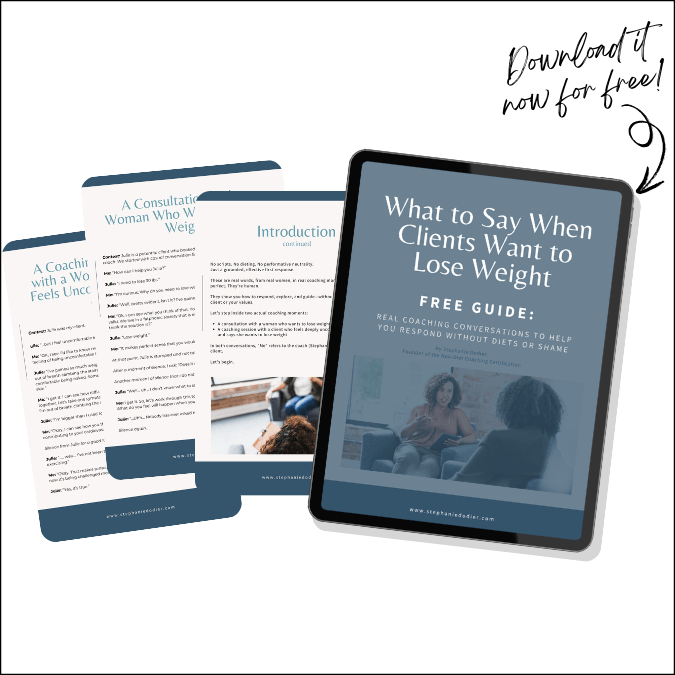
What To Say When Clients Want To Lose Weight Guide
Weight-Neutral Coaching Training
Full Episode Transcript
This transcript was auto-generated and lightly edited for clarity.
Click to expand the full transcript
What is the physiology of eating and how does it affect food choices?
The physiology of eating refers to the body’s internal biological signals that influence eating behavior. The three primary signals are hunger, fullness, and satisfaction cues. These signals travel from the body to the brain and drive decisions about when to eat, how much to eat, and when to stop. They are innate but can be suppressed by restriction, diet culture, and chronic override. When interoception awareness is low, the ability to sense these cues is diminished, making it harder to respond to actual nutritional needs. Restoring access to these signals requires addressing both physiological and psychological factors simultaneously.
Episode Transcript
[00:00:02] Stephanie: Welcome to Is Beyond the Food Podcast, my sister. I’m your host Stephanie Dosier, and today we are in part two. Of two in this series on eating behavior in part one, episode 458, we explore the psychology of eating, and if you haven’t listened to that episode yet, I invite you to pause this one and go back to 458 where I give you.
[00:00:30] Full context, the whole behavior model. And yes, my personal life update. ’cause right now we’re gonna skip all over the personal life update and why I am creating this episode because it is only one hour later from the prior episode, which by the way, is being recorded on March 31st and nothing has changed in my life.
[00:00:53] It is the same reason why I’m making this episode 459 as I’m making 458 and I will update you on my life in episode 460, which will be in a week from now when I record that episode. For now, we’re gonna skip all over that and we’re gonna move right into part two
[00:01:14] and today this part two is gonna focus on the physiology of eating.
[00:01:21] Or otherwise said, what is happening inside of your body at the biology level that influence what you eat, when you eat, how you, how much you eat, and why you eat. And I wanna tell you right now, this episode is not what you think it is. Stay with me.
[00:01:41] So just a reminder that this two part series came out of the curriculum work I have been doing as I’m preparing to launch the founder cohort of the groundwork, which is a brand new coaching experience that I’m launching in. April the 10th, you have to be enrolled for the founder cohorts of the groundwork.
[00:02:07] And then I’m gonna be repeating that ongoing every 10 to 12 weeks where it’s gonna be the way by which you start learning, integrating, and embodying. The beyond the food method, which is what I’ve been practicing under for the last 10 years of my professional practice. Think of it as a mentorship where you are embodying the non diet approach, a weight neutral approach to health under the umbrella of the, it’s beyond the food method.
[00:02:43] So as I’m preparing the background work for the groundwork, I wanted to embed a very specific approach to teaching, which is through practice. Because I want it to be not just a philosophy, not intellectual concept, but something tangible, measurable, where you can actually embody the non diet approach.
[00:03:10] And for that, I needed a very specific circumstance to work on with you, which is. Nutrition and eating behavior. And that’s how together we are going to learn the, beyond the food method and most important embodying it. So as I’m building this curriculum, one of the two layers of the beyond the food method is.
[00:03:40] Psychology of eating and the physiology of eating because those, through those two lenses on our eating behavior, I’m able to bring in so much tools and technique like. Riding the wave, like dialing up your nervous system for interoception awareness. Which leads me to the topic of today, which is the physiology of eating, which is strongly influenced or
[00:04:11] facilitated through your nervous system.
[00:04:15] So what is the physiology of eating? Simply put, it’s your body’s internal biological metabolic signals. It’s how your inner world is communicating with you to influence. Your eating behavior, which has for outcome, your nutritional needs, your nutrition. When you know, when we think of this broad concept of nutrition, it’s not something that we do like nutrition is just an umbrella term for the outcome of your eating behavior.
[00:04:55] You manifest. So those who love the manifestation, you manifest your nutrition through your eating behavior. So if you want to change your quote nutrition, it is done through influencing your eating behavior and your eating behavior are influenced through a broad. Spectrum of factor under the umbrella of psychology and a broad spectrum of factor under the physiology, which is that inner world that I was referring to, physical, biological, or even neuro biological element that influence your eating behavior.
[00:05:36] Therefore, your nutrition.
[00:05:38] Now I wanna caveat this by saying that we will focus today on elements of the physiology of eating that you have control over. And that’s very intentional because under the physiology of eating, we can be talking about things like hormones or neurotransmitter, which you do not have a direct control of.
[00:06:09] And we can get lost in that territory. And it’s often where actually wellness culture lands you into. It lands you into this place where it says, we’re gonna help you with your eating behavior by getting you to control your hormones like leptin and grille. And I’m saying that from lived experience because if you’re new here, I was deeply entrenched in diet, culture and dieted.
[00:06:42] From the age of 12 to the age of 38 years old, and I have done a ghrelin diet, I’ve done it, survived. It did nothing for me because it is not possible for us to control our Greta in our leptin no matter what you say. And when I say it’s not possible, meaning we do not have any evidence. There is no evidence that sustain, that we can control through external element like food choices or ghrelin level.
[00:07:16] It require at this stage i’m talking here in 2026. Don’t know when you’re gonna listen to this episode, but as of 2026. In order for you to affect ghrelin hormone level, you have to be deeply involved with medical intervention. You have to see specialists. It’s not something you can do at home regardless of what wellness culture tells you.
[00:07:45] So for the scope of this episode here, and for a scope of practice, if you are a. A professional, like a nutritionist, a dietician, a health coach. We wanna stay within our scope of practice, right? Evidence-based framework. We will focus on element of the physiology of eating, that we do have possibility of impact today here, and that is critically important for us to understand this for this episode.
[00:08:15] Now I wanna caveat also this to say, when we focus on the physiology of eating on things that we have. No control over without medical intervention like leptin, diet neurotransmitter just to name a few. It keeps us in this loop of believing that we are a problem to fix and. We need to do things to fix us our body.
[00:08:42] That is a problem to be solved. I call this the quote problem addiction pattern. It’s a coaching concept that I teach which says that we keep focusing on things to change ourselves because we believe ourselves to be a unique problem to fix, and this is. Very present when we start intervening or attempting to change the physiology of eating that we can actually impact.
[00:09:17] Instead of focusing on the things that we can impact, which I’m about to tell you what they are, and to tell you how to impact them, we instead say let me focus on all these other things here. That somehow I know I can’t really have control over and that’s not gonna give me results. And that’s going to keep me in the loop that I’m a problem to be fixed.
[00:09:42] You see what I’m saying? Problem addiction. So we’re not gonna talk about this today. We’re gonna talk about the things that we can actually have an impact.
[00:09:51] And these are three things, hunger. Fullness and satisfaction cues, otherwise known as eating cue. And I wanna talk to you about those eating cues or those signals that your body propagates internally in through your body so that it reach you cognitively and create a thoughts in your brain that says, oops.
[00:10:25] We’re hungry, right? These signals that create thoughts in your brain that makes you have the behavior of eating. If you’re hungry of saying, Ooh, I’m full, I’ll stop eating. Ooh, this was a really good meal. Satisfaction. Ooh, this really made me feel good and satisfied. I don’t need to eat again. I’m good for like four or five hours satisfaction.
[00:10:54] These are called eating cues or signal from your inner world into your cognition to create a behavior, and I want you to think of them as a dial on the stove. Every one of us is inborn is brought into this world. There’s always an exception. Let’s say 99.9% of us are born with three. Of those signals, hunger fullness and satisfaction.
[00:11:24] Now they’re innate, but they’re not always fully sense. What do I mean by that? Remember the dial, the stove dial I gave you for analogy. Some of us, their eating cues are on a. Nine outta 10. They’re full speed. We can sense them, we can sense a full scale of them. We can sense like a little bit of hunger, medium hunger, full hunger.
[00:11:54] Same thing with fullness and satisfaction. And for some of us, they’re like one out of 10, meaning we barely can feel when we’re hungry, let alone make a distinction between snack hunger versus full meal hunger.
[00:12:10] Why is that? Why is it that some of us, the dial is at one and for others, the dial is at 10? Because your body is incredibly intelligent, it learns to adapt. Adaptation is one of the primary factor as to why human being? Are where we are today is because we have this incredible capacity to adapt and we adapt also in our eating queue.
[00:12:44] So for all of us who have in the past. Restricted food, either volume of food, either types of food, either macro weight ratio of food like we have contained or eating choices. To some degree, we have restrained them, contained them, restricted them, what the body does in order to survive this restriction.
[00:13:13] Abnormal. Crisis phase because think about that. We have these inborn signal to eat when we’re hungry, stop when we’re full eating food that makes us feel good, that fulfill our nutrition needs, and then all of a sudden we say, Nope. We’re not going to eat to satisfy our nutrition needs. We’re going to starve ourselves voluntarily in order to shrink the size of our body to a adhere to societal standard.
[00:13:43] To look smaller if you’re a woman, to take less space, to be quiet, to be beautiful, and the body’s like, but hold on here. We’re hungry, we need more food. And you’re like, no, no, no, no, no. We need to eat less so we can lose weight. So what the body does, it adapts to that situation by tuning down the dial of interception awareness, so that dial on the stove as a technical term in biology, that’s called interoception awareness or the ability to sense our inner world.
[00:14:21] So this interoception awareness, very technical nerve, is one of the ways that your nervous system adapt to your external world. Your nervous system sends a threat starvation, right? It sends this, oh my God, there’s bread in front of me, and I’m born in a culture where we love bread. And I’m using my personal experience as a white European descent person.
[00:14:51] Like bread is in front of me. It’s at every meal. It’s been at every meal of my life, but all of a sudden I can’t eat bread ’cause quote, gluten’s not good for you, even though I’m not celiac, right? Just the whole gluten-free glaze and then you feel hungry. But really that’s not true. Like you don’t know how much you need to eat.
[00:15:09] The mathematical formula of macro does know. So in order to adapt to this crazy environment, your nervous system will tune down, down, regulate this system called interoception awareness so you don’t feel hungry, so you don’t feel dissatisfied because you can’t eat bread and you can survive the restrictive environment.
[00:15:34] Now, here’s another example of how this shows up. If you are someone who has learned about the eating cues, hunger, fullness, satisfaction, and you’ve read the book of Intuitive Eating and you skipped over. Unconsciously, this is most of my client. They unconsciously skip over the very specific exercise of creating your fullness scale.
[00:16:07] And some of you may like, ma, I didn’t read that in the book. I’m telling you it’s in the book, but your brain. Has decided that it was gonna discard that part because it’s very scary because for most of us, and this is where it specifically is relevant to women. This is why. So if you go back to the first episode on the psychology of eating, I made you aware that we need to broaden our scope to understand the social and cultural context of our individual client so we can understand.
[00:16:50] How their culture, their identity impact, how they think about food and about eating. So if you are someone who has been socialized to the thin ideal, you’re most likely have restricted food to some degree, quantity, or the type of food in order to manipulate the size of your body. You didn’t woke up deciding one morning you are going to restrict food.
[00:17:17] You’re like, no, I need to lose weight. ’cause I don’t feel confident or I don’t feel beautiful and I’m not attractive. So I need to lose weight. And in order to do that, I need to eat less. So eating and restriction is just a byproduct in order to achieve something else. And part of the rules around your dietary plan and protocol was probably not to quote overeat and not to eat past fullness because this is the key here.
[00:17:53] Fullness means you’ve ate. More than starvation should allow you. So in order to lose weight you need to stay in starvation mode to lose the weight. So if you feel full, that mean that you ate more than you should in order to lose weight. So
[00:18:11] you’ve learned as a woman that feeling full is not a good thing. In fact, for most women, I would say 70 to 80% of the thousand of women I work with, it’s a shameful experience. Feeling full is shameful. So in the intuitive eating process, when you are asked to create your own scale. Of fullness to experience, like a seven, a eight, a nine, and a 10.
[00:18:46] You’re like, hell no. ’cause that’s gonna create a lot of shame in me. So I’m not doing that. I’m gonna skip over. It’s not that important. That’s what I mean by unconsciously. You probably did that because the shame you felt in the past towards fullness incited you to not do it this time. And I know for me that was the case.
[00:19:10] I’m saying that from having worked with these women, and it’s the case for most women, and because I have lived through it, I hired a professional, intuitive eating counselor. Her name is Evelyn Oli. Some of you know her. She’s the author of the book. I’m like, as a professional, I’m gonna go to the top-notch people.
[00:19:29] I’m gonna hire her Back in the day, she used to work with people 1 0 1. And she made me do the exercise that I didn’t wanna do, that I skipped over when I read the book the first time, because of all the shame I had embedded all over me. For 25 years that being full is bad as a woman is going to either make me gain weight or prevent me from losing weight.
[00:19:57] So I had a lot of taught work to do there and a lot of building the skill to feel the shame because I triggered myself, right? I ate like an eight, nine outta 10, and then I got overwhelmed by shame. Because of all the traumatic past experience of eating past full and binge eating, I had to provoke that in me in order to bring safety to it.
[00:20:31] You see how nuanced this work can be. That’s how it needs to be approached, either from you to you or from you as a professional to your client. We need to have the full, broad skillset, not just tell people, fill your fullness and stop eating. Oh my God. It’s not that simple. So if you’re listening to this, you’re like, oh my God, that’s probably why I’m struggling.
[00:20:58] Yes, it’s probably why, because it’s a very nuance. Approach the physiology of eating when you understand also the psychology of eating, and that’s how the two kind of intertwine together. So yeah, it’s hunger full and satisfaction. But behind that, there’s also the thoughts and the belief about hunger.
[00:21:25] Like for some people it’s good to be hungry. We have to unpack that. For some people, you feel shame to be full, have to unpack that, and for most. Women, there’s a shame around feeling satisfied with food. Why you ask? Let me tell you why. Because satisfaction means that you likely ate food that you weren’t supposed to eat or that you ate.
[00:21:51] Such a quantity of food that you feel full and satisfy. And that’s something to be ashamed of because you are not gonna lose weight. So even though you may have let go of the desire to lose weight, which it’s a long process, but let’s imagine you did. If you haven’t worked through the thought associated with that, it may still be playing out in the background.
[00:22:16] Downregulating your ability to feel the satisfaction and know which food makes you feel satisfied. Which food, food fulfill your nutritional needs, and the hunger and the fullness.
[00:22:31] So how do we change that? How do we affect the physiology of eating? So if you are a health professional, if you’re a coach, number one is understanding that nutrition is more than just macro, micro pro and formula and mathematical integration, which 99% of the chance if you’re listening to this podcast, you know that.
[00:22:57] You live that now understanding the next layer of complexity when it comes to eating behavior is probably where you are at. And as I recommended in Podcast 458, I will recommend the same thing here. Go and download the non Diet coaching assessment tool, which is a free tool that I created that’s available on the internet.
[00:23:19] On my website in the show note, and one of the three assessment tool is the eating behavior. Do not use that on your client without using it on yourself, because chances are you are in the field of nutrition or health because you have your own experience with health or with. Diet culture. So it’s much likely that your own eating behavior are dysregulated, disordered, and that it’s one of the two component, most likely both that needs some help.
[00:23:57] Better way of saying some healing, some counseling, so it’s either physiology or psychology, most likely the both. And that tool has 20 questions that are either from. Psychological factor or physiological factor. So by the nature of the question, you will be able to understand which one is at play for you.
[00:24:18] As I said, it’s probably both. And then you need the tools to be able to facilitate that change in you first, right? And in your client as well. And these tools is what we teach in the groundwork or within the non diet coaching certification. If you are a woman on her own journey I would recommend the same path.
[00:24:43] Go and download the non diet coaching assessment tool and that will help you identify if you need help. Right now, if you need help based on your economical status, you may listen to some other free podcast episode, or you may invest in working with me in the groundwork. And the same thing for professional.
[00:25:05] If you’re doing the assessment and you find some gap in yourself, the first line is to work with me in the groundwork where we. Unpack tools for you to do your own groundwork, your own personal work that will get you ready to move into the non diet coaching certification, if that’s is your path for you professionally.
[00:25:28] Now I wanna name something before we close this episode here. Although we are focused on the physiology of eating, we cannot work on the physiology of eating hunger full and satisfaction cue without. Intertwining with emotional work because it’s the same system. The interoception awareness, if we find that there is a downregulated interoception awareness it’s is more than most likely.
[00:26:04] It is probably that you cannot sense the sensation associated with emotion and probably you are emotionally dysregulated as well. Again. It’s the same system. You can’t have a high emotional awareness and a low physiological eating awareness. So just be ready as we hit that. It’s not just one without the other, it comes together.
[00:26:30] That’s why I created the groundwork so we can do this work together, both physiology and psychology, using the tool of the going to beyond the food method. And it takes time. It’s not something that’s done. By the click of a finger. That’s why I’m giving you access in the groundwork to 12 months with me as your coach, because it’s gonna take time to embody and make the change at the nervous system level, at the psychological level, so that it becomes second nature, quote unquote embodiments.
[00:27:06] So if that an interest for you, again, the groundwork, the link is in the show note associated with this podcast. It was a pleasure being with you, my sister. I’ll see you on the next podcast episode.
[00:27:22] Stephanie: If this resonates with you, the next step is the groundwork, my Beyond the Food Foundational Program for Health Professional, ready to go beyond the food and rethink how they approach nutrition eating and health behavior starting with themselves. You can go to www.stephaniedodier.com/groundwork and join us now.